미적분Ⅰ도함수의 활용수능 기출킬러 문제 (22·30번 수준)

사차함수 실근 개수

문제

최고차항의 계수가 양수인 사차함수 f(x)f ( x )가 있다. 실수 tt에 대하여 함수 g(x)g ( x )g(x)=f(x)xf(t)+tg \left( x \right) = f \left( x \right) - x - f \left( t \right) + t 라 할 때, 방정식 g(x)=0g ( x ) = 0의 서로 다른 실근의 개수를 h(t)h ( t )라 하자. 두 함수 f(x)f ( x )h(t)h ( t )가 다음 조건을 만족시킨다.

(가) limt1{h(t)h(1)}=limt1{h(t)h(1)}=2\displaystyle \lim\limits _{t \rightarrow - 1} \left\{ h ( t ) - h ( - 1 ) \right\} = \lim\limits _{t \rightarrow 1} \left\{ h ( t ) - h ( 1 ) \right\} = 2 (나) 0αf(x)dx=0αf(x)dx\displaystyle \int _{0} ^{\alpha} {} f \left( x \right) dx = \int _{0} ^{\alpha} {} | f \left( x \right) | dx를 만족시키는 실수 α\alpha의 최솟값은 1\mathrm{-} 1이다. (다) 모든 실수 xx에 대하여 ddx0x{f(u)ku}du0\displaystyle \frac{d}{dx} \int _{0} ^{x} {} \left\{ f \left( u \right) - ku \right\} du \geq 0이 되도록 하는 실수 kk의 최댓값은 f(2)\displaystyle f' ( \sqrt{2} )이다.

f(6)f ( 6 )의 값을 구하시오. [4점]

정답 보기
182

자료 내려받기

아직 올라온 파일이 없습니다.

해설

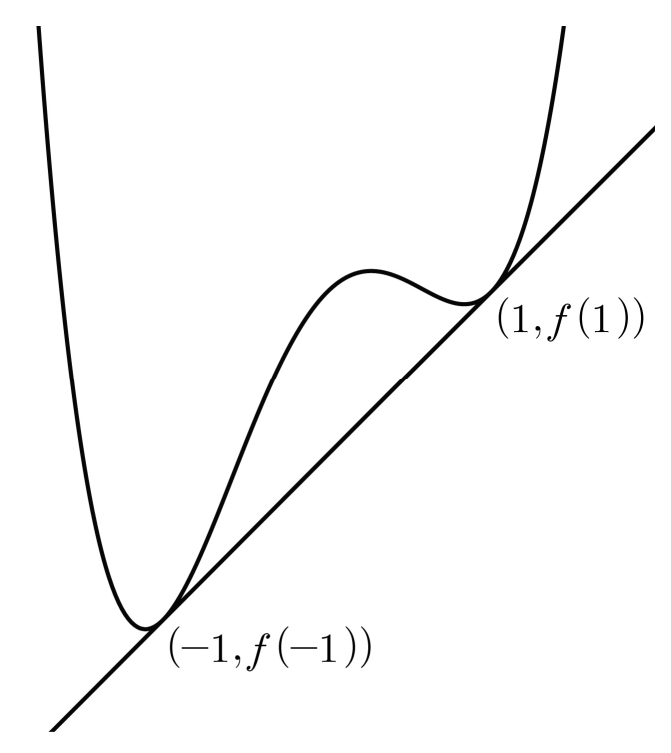
방정식 g(x)=0g ( x ) = 0에서 x=tx = t일 때 f(t)tf(t)+t=0f \left( t \right) - t - f \left( t \right) + t = 0이므로 g(t)=0g \left( t \right) = 0 xtx \neq t일 때 f(x)xf(t)+t=0f \left( x \right) - x - f \left( t \right) + t = 0에서 f(x)f(t)xt=1\displaystyle \frac{f \left( x \right) - f \left( t \right)}{x - t} = 1이다. 그러므로 함수 h(t)h ( t )는 곡선 y=f(x)y = f ( x ) 위의 한 점 (t,f(t))( t , f ( t ) )를 지나고 기울기가 1\mathrm{1}인 직선 ll과 곡선 y=f(x)y = f ( x )의 교점의 개수이다. 임의의 실수 ss에 대하여 h(s)1h ( s ) \geq 1이다. (ⅰ) h(s)=1h ( s ) = 1인 경우

limtsh(t)=2\displaystyle \lim\limits _{t \rightarrow s} h ( t ) = 2이므로 limts{h(t)h(s)}=1\displaystyle \lim\limits _{t \rightarrow s} \left\{ h ( t ) - h ( s ) \right\} = 1

(ⅱ) h(s)=2h ( s ) = 2인 경우

limtsh(t)=2\displaystyle \lim\limits _{t \rightarrow s} h ( t ) = 2이므로 limts{h(t)h(s)}=0\displaystyle \lim\limits _{t \rightarrow s} \left\{ h ( t ) - h ( s ) \right\} = 0
limtsh(t)=2\displaystyle \lim\limits _{t \rightarrow s} h ( t ) = 2이므로 limts{h(t)h(s)}=0\displaystyle \lim\limits _{t \rightarrow s} \left\{ h ( t ) - h ( s ) \right\} = 0limtsh(t)=4\displaystyle \lim\limits _{t \rightarrow s} h ( t ) = 4이므로 limts{h(t)h(s)}=2\displaystyle \lim\limits _{t \rightarrow s} \left\{ h ( t ) - h ( s ) \right\} = 2

(ⅲ) h(s)3h ( s ) \geq 3인 경우 limtsh(t)=4\displaystyle \lim\limits _{t \rightarrow s} {} h ( t ) = 4이거나 극한값이 존재하지 않는다. (ⅰ), (ⅱ), (ⅲ)에 의하여 곡선 y=f(x)y = f ( x )와 직선 ll이 두 점 (1,f(1))( - 1 , f ( - 1 ) ), (1,f(1))( 1 , f ( 1 ) )에서 접할 때 limt1{h(t)h(1)}=limt1{h(t)h(1)}=2\displaystyle \lim\limits _{t \rightarrow - 1} {} \left\{ h \left( t \right) - h \left( - 1 \right) \right\} = \lim\limits _{t \rightarrow 1} {} \left\{ h \left( t \right) - h \left( 1 \right) \right\} = 2를 만족시킨다.

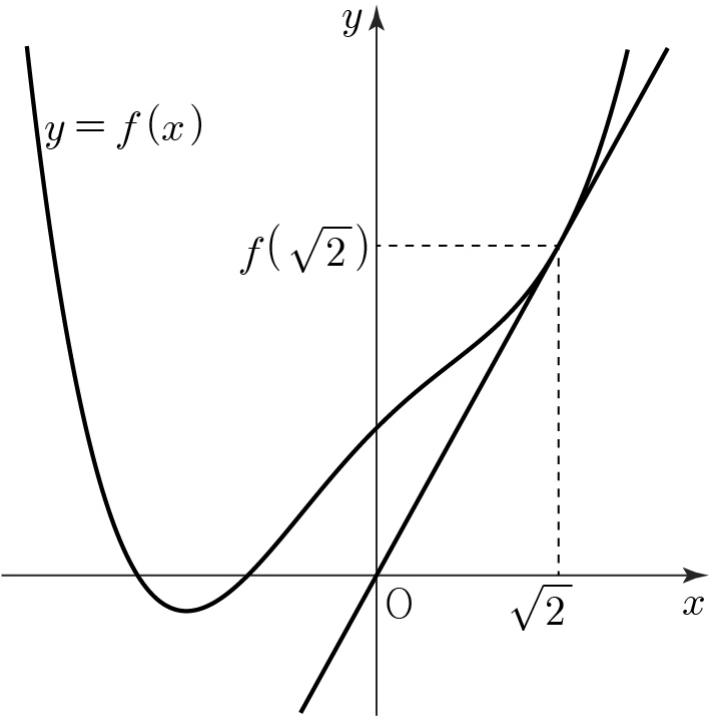
함수 f(x)f ( x )의 최고차항의 계수를 aa, 직선 ll의 방정식을 y=x+by = x + b라 하자. (단, aa, bb는 상수) f(x)(x+b)=a(x1)2(x+1)2f \left( x \right) - \left( x + b \right) = a \left( x - 1 \right) ^{2} \left( x + 1 \right) ^{2} f(x)=a(x1)2(x+1)2+x+bf \left( x \right) = a \left( x - 1 \right) ^{2} \left( x + 1 \right) ^{2} + x + b 조건 (나)에서 0α{f(x)f(x)}dx=0\displaystyle \int _{0} ^{\alpha} {} \left\{ f \left( x \right) - \left| f \left( x \right) \right| \right\} dx = 0을 만족시키는 실수 α\alpha의 최솟값이 1\mathrm{-} 1이므로 1x0- 1 \leq x \leq 0에서 f(x)0f ( x ) \geq 0, f(1)0f ( - 1 ) \geq 0 f(1)>0f ( - 1 ) > 0이면 실수 α\alpha의 최솟값이 1\mathrm{-} 1이 아니므로 f(1)=0f ( - 1 ) = 0 f(1)=1+b=0f \left( - 1 \right) = - 1 + b = 0, b=1b = 1 f(x)=a(x1)2(x+1)2+x+1f \left( x \right) = a \left( x - 1 \right) ^{2} \left( x + 1 \right) ^{2} + x + 1 조건 (다)에서 ddx0x{f(u)ku}du=f(x)kx0\displaystyle \frac{d}{dx} \int _{0} ^{x} {} \left\{ f \left( u \right) - ku \right\} du = f \left( x \right) - kx \geq 0 f(x)kxf \left( x \right) \geq kx이므로 곡선 y=f(x)y = f ( x )와 직선 y=kxy = k x가 접하거나 만나지 않는다. 실수 kk의 최댓값이 f(2)\displaystyle f' \left( \sqrt{2} \right)이므로 그림과 같이곡선 y=f(x)y = f ( x )와 직선 y=f(2)x\displaystyle y = f' \left( \sqrt{2} \right) x가 점 (2,f(2))\displaystyle ( \sqrt{2} , f ( \sqrt{2} ) )에서 접한다.

f(x)f ( x )=a(x1)2(x+1)2+x+1= a ( x - 1 ) ^{2} ( x + 1 ) ^{2} + x + 1=ax42ax2+x+a+1= ax ^{4} - 2 ax ^{2} + x + a + 1 f(x)=4ax34ax+1f' \left( x \right) = 4 ax ^{3} - 4 ax + 1 f(2)=4a4a+2+a+1=a+2+1\displaystyle f \left( \sqrt{2} \right) = 4 a - 4 a + \sqrt{2} + a + 1 = a + \sqrt{2} + 1 f(2)=82a42a+1=42a+1\displaystyle f' \left( \sqrt{2} \right) = 8 \sqrt{2} a - 4 \sqrt{2} a + 1 = 4 \sqrt{2} a + 1 f(2)=f(2)×2\displaystyle f \left( \sqrt{2} \right) = f' \left( \sqrt{2} \right) \times \sqrt{2}이므로 a+2+1\displaystyle a + \sqrt{2} + 1=(42a+1)×2\displaystyle = \left( 4 \sqrt{2} a + 1 \right) \times \sqrt{2}=8a+2\displaystyle = 8 a + \sqrt{2} a=17\displaystyle a = \frac{1}{7}, f(x)=17(x1)2(x+1)2+x+1\displaystyle f ( x ) = \frac{1}{7} ( x - 1 ) ^{2} ( x + 1 ) ^{2} + x + 1 따라서 f(6)=17×52×72+6+1=182\displaystyle f ( 6 ) = \frac{1}{7} \times 5 ^{2} \times 7 ^{2} + 6 + 1 = 182

태그

비슷한 문제 더 보기

← 전체 문제 목록으로