대수삼각함수의 활용수능 기출발전 문제 (3점 후반~4점 초반)

원에 내접하는 사각형 빈칸

문제

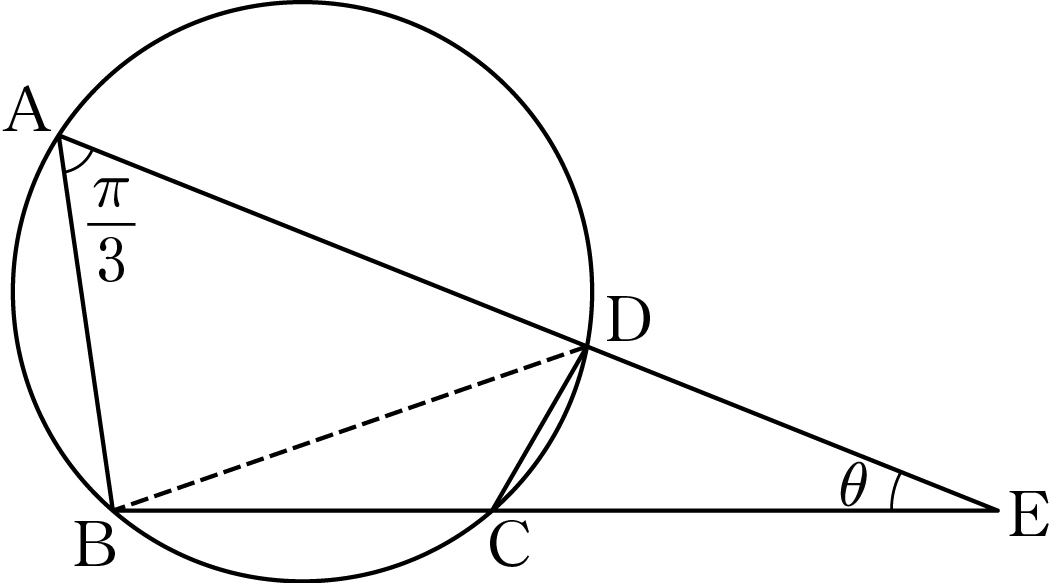
그림과 같이 원에 내접하는 사각형 ABCD\mathrm{ABCD}에 대하여 AB=BC=2\displaystyle \mathrm{\overline{AB}} = {\overline{BC}} = 2, AD=3\displaystyle \mathrm{\overline{AD}} = 3, BAD=π3\displaystyle \mathrm{\angle} BAD = \frac{\pi}{3} 이다. 두 직선 AD\mathrm{AD}, BC\mathrm{BC}의 교점을 E\mathrm{E}라 하자.

다음은 AEB=θ\mathrm{\angle} AEB = \theta일 때, sinθ\sin \theta의 값을 구하는 과정이다.

삼각형 ABD\mathrm{ABD}와 삼각형 BCD\mathrm{BCD}에서 코사인법칙을 이용하면 CD=()\displaystyle \mathrm{\overline{CD}} = {\square {{}^{} ( \text{가} ) ^{}}} 이다. 삼각형 EAB\mathrm{EAB}와 삼각형 ECD\mathrm{ECD}에서 AEB\mathrm{\angle} AEB는 공통, EAB\mathrm{\angle} EAB=ECD= \mathrm{\angle} ECD 이므로 삼각형 EAB\mathrm{EAB}와 삼각형 ECD\mathrm{ECD}는 닮음이다. 이를 이용하면 ED=()\displaystyle \mathrm{\overline{ED}} = {\square {{}^{} ( \text{나} ) ^{}}} 이다. 삼각형 ECD\mathrm{ECD}에서 사인법칙을 이용하면 sinθ\sin \theta=()= {\square {{}^{} ( \text{다} ) ^{}}} 이다.

위의 (가), (나), (다)에 알맞은 수를 각각 pp, qq, rr라 할 때, (p+q)×r\left( p + q \right) \times {r}의 값은? [4점] 32\displaystyle \frac{\sqrt{3}}{2}437\displaystyle \frac{4 \sqrt{3}}{7}9314\displaystyle \frac{9 \sqrt{3}}{14}537\displaystyle \frac{5 \sqrt{3}}{7}11314\displaystyle \frac{11 \sqrt{3}}{14}

정답 보기

자료 내려받기

아직 올라온 파일이 없습니다.

해설

[출제의도] 코사인법칙과 사인법칙을 이용하여 각의 사인값을 추론한다. 삼각형 ABD\mathrm{ABD}와 삼각형 BCD\mathrm{BCD}에서 코사인법칙을 이용하여 선분 CD\mathrm{CD}의 길이를 구하자. 삼각형 ABD\mathrm{ABD}에서 코사인법칙에 의하여 BD2\displaystyle {\overline{\mathrm{BD}}} ^{2}=32+222×3×2×cosπ3\displaystyle = 3 ^{2} + 2 ^{2} - 2 \times 3 \times 2 \times \mathrm{\cos} \frac{\pi}{3}=7= 7 이므로 BD=7\displaystyle \mathrm{\overline{BD}} = \sqrt{7}이다. BAD+BCD=π\mathrm{\angle} BAD + \angle BCD = \pi이므로 삼각형 BCD\mathrm{BCD}에서 코사인법칙에 의하여 22+CD22×2×CD×cos2π3\displaystyle 2 ^{2} + {\overline{\mathrm{CD}}} ^{2} - 2 \times 2 \times {\overline{\mathrm{CD}}} \times {\cos \frac{2 \pi}{3}}=7= 7 이므로 CD=1\displaystyle {\overline{\mathrm{CD}}} = \square {1}이다. 삼각형 EAB\mathrm{EAB}와 삼각형 ECD\mathrm{ECD}에서 AEB\mathrm{\angle} AEB는 공통이고 EAB\mathrm{\angle} EAB=ECD= \mathrm{\angle} ECD이므로 삼각형 EAB\mathrm{EAB}와 삼각형 ECD\mathrm{ECD}는 닮음이다. 따라서 EAEC\displaystyle \frac{{\overline{\mathrm{EA}}}}{{\overline{\mathrm{EC}}}}=EBED\displaystyle = \frac{{\overline{\mathrm{EB}}}}{{\overline{\mathrm{ED}}}}=ABCD\displaystyle = \frac{{\overline{\mathrm{AB}}}}{{\overline{\mathrm{CD}}}}이다. 즉, 3+EDEC=2+ECED=21\displaystyle \frac{3 + {\overline{\mathrm{ED}}}}{{\overline{\mathrm{EC}}}} = \frac{2 + {\overline{\mathrm{EC}}}}{{\overline{\mathrm{ED}}}} = \frac{2}{1} 에서 ED=73\displaystyle {\overline{\mathrm{ED}}} = {\square {\frac{7}{3}}}이다. DCE\mathrm{\angle} DCE=πBCD= \pi - \mathrm{\angle} BCD=BAD= \mathrm{\angle} BAD=π3\displaystyle = \frac{\pi}{3} 이므로 삼각형 ECD\mathrm{ECD}에서 사인법칙을 이용하면 73sinπ3=1sinθ\displaystyle \frac{\frac{7}{3}}{\sin \frac{\pi}{3}} = \frac{1}{\sin \theta} 에서 sinθ\sin \theta=3314\displaystyle = {\square {\frac{3 \sqrt{3}}{14}}}이다. p=1p = 1, q=73\displaystyle q = \frac{7}{3}, r=3314\displaystyle r = \frac{3 \sqrt{3}}{14}이므로 (p+q)×r\left( p + q \right) \times {r}=(1+73)×3314\displaystyle = \left( 1 + \frac{7}{3} \right) \times \frac{3 \sqrt{3}}{14}=537\displaystyle = \frac{5 \sqrt{3}}{7}

태그

비슷한 문제 더 보기

← 전체 문제 목록으로