대수수열의 합수능 기출발전 문제 (3점 후반~4점 초반)

수선과 삼각형 넓이 빈칸

문제

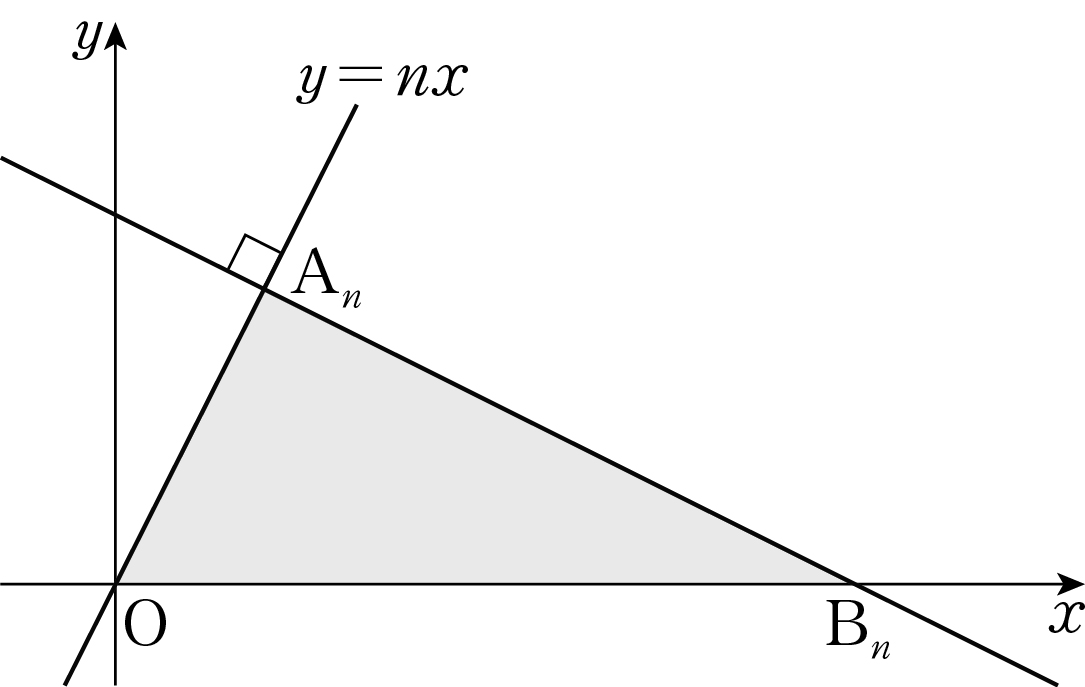
자연수 nn에 대하여 점 An(n,n2)\mathrm{A} _{\mathit{n}} \mathit{\left( n , n ^{2} \right)}을 지나고 직선 y=nxy = nx에 수직인 직선이 xx축과 만나는 점을 Bn\mathrm{B} _{\mathit{n}}이라 하자.

다음은 삼각형 AnOBn\mathrm{A} _{\mathit{n}} \mathrm{OB} _{\mathit{n}}의 넓이를 SnS _{n}이라 할 때, n=18Snn3\displaystyle \sum\limits _{n=1} ^{8} \frac{S _{n}}{n ^{3}}의 값을 구하는 과정이다. (단, O\mathrm{O}는 원점이다.)

An(n,n2)\mathrm{A} _{\mathit{n}} \mathit{\left( n , n ^{2} \right)}을 지나고 직선 y=nxy = nx에 수직인 직선의 방정식은 y=()×x+n2+1y = \mathit{\square} {( \text{가} ) ^{}} \times x + n ^{2} + 1 이므로 두 점 An\mathrm{A} _{\mathit{n}}, Bn\mathrm{B} _{\mathit{n}}의 좌표를 이용하여 SnS _{n}을 구하면 Sn=()S _{n} = \square {( \text{나} )} 따라서 n=18Snn3=()\displaystyle \sum\limits _{n=1} ^{8} \frac{S _{n}}{n ^{3}} = {{\square {( \text{다} ) ^{}}}} 이다.

위의 (가), (나)에 알맞은 식을 각각 f(n)f ( n ), g(n)g ( n )이라 하고, (다)에 알맞은 수를 rr라 할 때, f(1)+g(2)+rf ( 1 ) + g ( 2 ) + r의 값은? [4점] 105105110110115115120120125125

정답 보기

자료 내려받기

아직 올라온 파일이 없습니다.

해설

[출제의도] 수열의 합을 구하는 과정을 추론한다. 점 An(n,n2)\mathrm{A} _{\mathit{n}} \left( \mathit{n} , n ^{2} \right)을 지나고 직선 yy=nx= nx에 수직인 직선의 기울기는 1n\displaystyle - \frac{1}{n}이므로 직선의 방정식은 yn2y - n ^{2}=1n(xn)\displaystyle = \mathit{-} \frac{1}{n} ( x - n ), yy=1n×x+n2+1\displaystyle = \mathit{\square} {- {\frac{1}{n}}} \times x + n ^{2} + 1 즉, ()\square {( \text{가} )}=1n\displaystyle = \mathit{-} \frac{1}{n}Bn\mathrm{B} _{\mathit{n}}의 좌표는 1nx+n2+1\displaystyle - \frac{1}{n} x + n ^{2} + 1=0= 0에서 (n3+n,0)\left( \mathit{n} ^{3} + n , 0 \right)An\mathrm{A} _{\mathit{n}}의 좌표는 (n,n2)\left( n , n ^{2} \right)이므로 SnS _{n}=12×(n3+n)×n2\displaystyle = \frac{1}{2} \times \left( n ^{3} + n \right) \times n ^{2}=n5+n32\displaystyle = \square {\frac{n ^{5} + n ^{3}}{2}} 즉, ()\square {( \text{나} )}=n5+n32\displaystyle = \frac{n ^{5} + n ^{3}}{2} n=18Snn3\displaystyle \sum\limits _{n=1} ^{8} \frac{S _{n}}{n ^{3}}=n=18n5+n32n3\displaystyle = \sum\limits _{n=1} ^{8} \frac{n ^{5} + n ^{3}}{2 n ^{3}}=n=18n2+12\displaystyle = \sum\limits _{n=1} ^{8} \frac{n ^{2} + 1}{2} =12n=18n2+12n=181\displaystyle = \frac{1}{2} \sum\limits _{n=1} ^{8} n ^{2} + \frac{1}{2} \sum\limits _{n=1} ^{8} 1 =12×8×9×176+12×1×8\displaystyle = \frac{1}{2} \times \frac{8 \times 9 \times 17}{6} + \frac{1}{2} \times 1 \times 8 =102+4= 102 + 4=106= {{\square {106}}} 즉, ()\square {( \text{다} )}=106= 106 따라서 f(n)f ( n )=1n\displaystyle = \mathit{-} \frac{1}{n}, g(n)g ( n )=n5+n32\displaystyle = \frac{n ^{5} + n ^{3}}{2}, rr=106= 106이므로 f(1)+g(2)+rf ( 1 ) + g ( 2 ) + r=1+20+106= \mathit{-} 1 + 20 + 106=125= 125

태그

비슷한 문제 더 보기

← 전체 문제 목록으로