기하공간벡터수능 기출킬러 문제 (22·30번 수준)

공간벡터 내적 최대

문제

좌표공간에서 두 점 A(0,0,2)\mathrm{A} ( 0 , 0 , 2 ), B(2,4,2)\mathrm{B} ( 2 , 4 , - 2 )에 대하여 두 점 P\mathrm{P}, Q\mathrm{Q}가 다음 조건을 만족시킨다.

(가) OAOP=0\mathrm{\vec{OA}} \bullet {\vec{OP}} = 0, OP=3\left| {\vec{\mathrm{OP}}} \right| = 3 (나) ABBQ=0\mathrm{\vec{AB}} \bullet {\vec{BQ}} = 0, BQ=2\left| {\vec{\mathrm{BQ}}} \right| = 2

OPAQ\mathrm{\vec{OP}} \bullet {\vec{AQ}}의 최댓값이 a+b5\displaystyle a + b \sqrt{5}일 때, 두 유리수 aa, bb에 대하여 abab의 값을 구하시오. (단, O\mathrm{O}는 원점이다.) [4점]

정답 보기
24

자료 내려받기

아직 올라온 파일이 없습니다.

해설

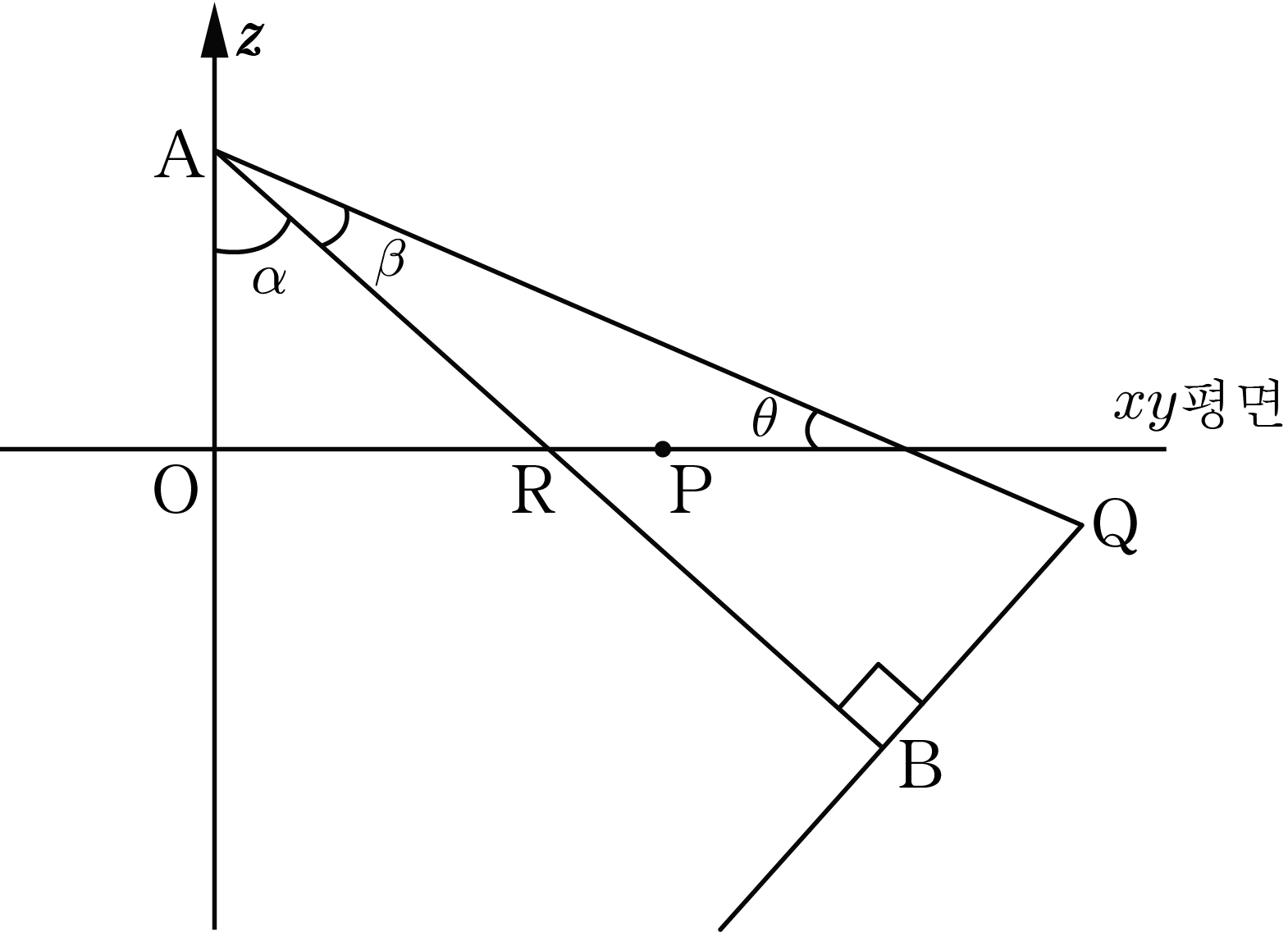
[출제의도] 공간벡터의 성질을 이용하여 두 벡터의 내적의 최댓값을 구하는 문제를 해결한다. 두 벡터 OP\mathrm{\vec{OP}}AQ\vec{\mathrm{A}} Q의 크기가 일정하므로 OPAQ\mathrm{\vec{OP}} \bullet {\vec{AQ}}는 두 벡터가 이루는 각이 최소일 때 최댓값을 갖는다. 다섯 개의 점 O\mathrm{O}, A\mathrm{A}, B\mathrm{B}, P\mathrm{P}, Q\mathrm{Q}가 한 평면에 있도록 그림으로 나타내면 다음과 같고 OPAQ\mathrm{\vec{OP}} \bullet {\vec{AQ}}OP\left| \mathrm{\vec{OP} |} \right.와 선분 AQ\mathrm{AQ}xyxy평면으로의 정사영의 길이의 곱과 같다.

그림에서 BAO=α\mathrm{\angle} BAO = \alpha, QAB=β\mathrm{\angle} QAB = \beta, xyxy평면과 직선 AQ\mathrm{{AQ}}가 이루는 각의 크기를 θ\theta라 하면 cosθ=cos(π2αβ)=sin(α+β)\displaystyle \cos \theta = \cos \left( \frac{\pi}{2} - \alpha - \beta \right) = \sin \left( \alpha + \beta \right)이므로 선분 AQ\mathrm{AQ}xyxy평면으로의 정사영의 길이는 AQsin(α+β)\left| \mathrm{\vec{AQ}} \right| \sin ( \alpha + \beta )이다. AB=22+42+(4)2=6\displaystyle \mathrm{\overline{AB}} = \sqrt{2 ^{2} + 4 ^{2} + ( - 4 ) ^{2}} = 6, BQ=2\displaystyle \mathrm{\overline{BQ}} = 2이므로 AQ=210\displaystyle \mathrm{\overline{AQ}} = 2 \sqrt{10} 그러므로 sinβ=1010\displaystyle \sin \beta = \frac{\sqrt{10}}{10}, cosβ=31010\displaystyle \cos \beta = \frac{3 \sqrt{10}}{10} 방향벡터가 (2,4,4)( 2 , 4 , - 4 )이고 점 A(0,0,2)\mathrm{A} ( 0 , 0 , 2 )를 지나는 직선 AB\mathrm{AB}의 방정식은 x2=y4=z24\displaystyle \frac{x}{2} = \frac{y}{4} = \frac{z - 2}{- 4}이다. 이 직선과 xyxy평면과의 교점을 R\mathrm{R}라 하면 직선 AB\mathrm{AB}의 방정식에서 z=0z = 0일 때이므로 점 R\mathrm{R}의 좌표는 (1,2,0)( 1 , 2 , 0 )이다. AR=12+22+22=3\displaystyle \mathrm{\overline{AR}} = \sqrt{1 ^{2} + 2 ^{2} + 2 ^{2}} = 3, AO=2\displaystyle \mathrm{\overline{AO}} = 2이므로 OR=5\displaystyle \mathrm{\overline{OR}} = \sqrt{5} 그러므로 sinα=53\displaystyle \sin \alpha = \frac{\sqrt{5}}{3}, cosα=23\displaystyle \cos \alpha = \frac{2}{3} 따라서 AQsin(α+β)\left| \mathrm{\vec{AQ}} \right| \sin ( \alpha + \beta ) =210×(53×3101023×1010)\displaystyle = 2 \sqrt{10} \times \left( \frac{\sqrt{5}}{3} \times \frac{3 \sqrt{10}}{10} \right. \frac{2}{3} \times \frac{\sqrt{10}}{10} ) =65+43\displaystyle = \frac{6 \sqrt{5} + 4}{3} OPAQ\mathrm{\vec{OP}} \bullet {\vec{AQ}}=OPAQcosθ= \left| \vec{\mathrm{O}} P \right| \left| \vec{AQ} \right| \cos \theta =OPAQsin(α+β)= \left| \vec{\mathrm{O}} P \right| \left| \vec{AQ} \right| \sin ( \alpha + \beta ) =3×65+43\displaystyle = 3 \times \frac{6 \sqrt{5} + 4}{3}=65+4\displaystyle = 6 \sqrt{5} + 4 따라서 a=4a = 4, b=6b = 6이므로 ab=ab =4×6=244 \times 6 = 24

태그

비슷한 문제 더 보기

← 전체 문제 목록으로