미적분Ⅱ도함수의 활용수능 기출킬러 문제 (22·30번 수준)

기울기 최솟값 함수 미분

문제

양수 tt에 대하여 구간 [1,)[ 1 , \infty )에서 정의된 함수 f(x)f \left( x \right)f(x)={lnx(1x<e)t+lnx(xe)\displaystyle f \left( x \right) = {\begin{cases} \begin{aligned} \ln x \\ \end{aligned} & \begin{aligned} \left( 1 \leq x < e \right) \\ \end{aligned} \\ - t + \ln x & \left( x \geq e \right) \end{cases}} 일 때, 다음 조건을 만족시키는 일차함수 g(x)g \left( x \right) 중에서 직선 y=g(x)y = g \left( x \right)의 기울기의 최솟값을 h(t)h \left( t \right)라 하자.

11 이상의 모든 실수 xx에 대하여 (xe){g(x)f(x)}0\left( x - e \right) \left\{ g \left( x \right) - f \left( x \right) \right\} \geq 0 이다.

미분가능한 함수 h(t)h \left( t \right)에 대하여 양수 aah(a)=1e+2\displaystyle h \left( a \right) = \frac{1}{e + 2}을 만족시킨다. h(12e)×h(a)\displaystyle h' \left( \frac{1}{2 e} \right) \times h' \left( a \right)의 값은? [4점] 1(e+1)2\displaystyle \frac{1}{\left( e + 1 \right) ^{2}}1e(e+1)\displaystyle \frac{1}{e \left( e + 1 \right)}1e2\displaystyle \frac{1}{e ^{2}}1(e1)(e+1)\displaystyle \frac{1}{\left( e - 1 \right) \left( e + 1 \right)}1e(e1)\displaystyle \frac{1}{e \left( e - 1 \right)}

정답 보기

자료 내려받기

아직 올라온 파일이 없습니다.

해설

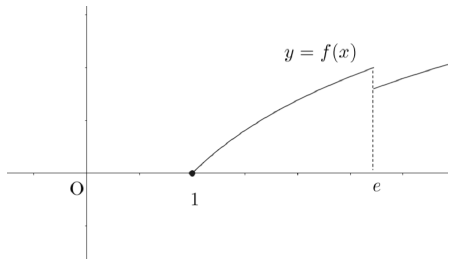
[출제의도] 합성함수의 미분법을 이용하여 미분계수를 구할 수 있는가? 함수 f(x)f \left( x \right)의 그래프는 다음과 같다.

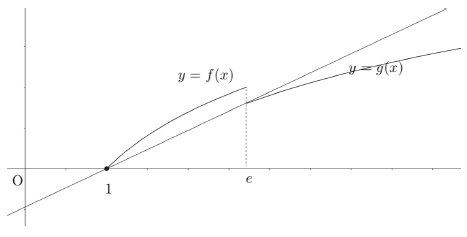
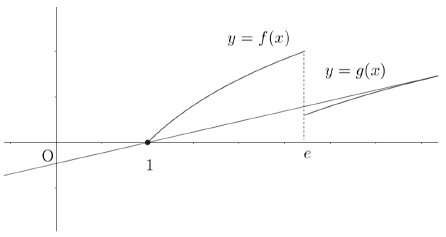
이때 일차함수 g(x)g \left( x \right)가 주어진 조건을 만족시키려면 1x<e1 \leq x < e일 때 g(x)f(x)g \left( x \right) \leq f \left( x \right)이고, xex \geq e일 때 g(x)f(x)g \left( x \right) \geq f \left( x \right)이어야 한다. 따라서 일차함수 g(x)g \left( x \right)의 기울기의 최솟값 h(t)h \left( t \right)는 다음과 같다. (ⅰ) 점 (1,0)\left( 1 , 0 \right)에서 곡선 y=t+lnx(xe)y = - t + \ln x \left( x \geq e \right)에 그은 접선이 존재하지 않을 때

두 점 (1,0)\left( 1 , 0 \right), (e,f(e))\left( e , f \left( e \right) \right)를 지나는 직선의 기울기가 h(t)h \left( t \right)이다. 즉, h(t)=t+lnee1=t+1e1\displaystyle h \left( t \right) = \frac{- t + \ln e}{e - 1} = \frac{- t + 1}{e - 1}이다. 이때, h(t)=1e1\displaystyle h' \left( t \right) = \frac{- 1}{e - 1}이므로 h(12e)=1e1\displaystyle h' \left( \frac{1}{2 e} \right) = \frac{- 1}{e - 1} (ⅱ) 점 (1,0)\left( 1 , 0 \right)에서 곡선 y=t+lnx(xe)y = - t + \ln x \left( x \geq e \right)에 그은 접선이 존재할 때

그 접선의 기울기가 h(t)h \left( t \right)이다. 이때 f(x)=1x(xe)\displaystyle f' \left( x \right) = \frac{1}{x} \left( x \ne e \right)이므로 접점의 xx좌표를 α\alpha라 하면 h(t)=1α\displaystyle h \left( t \right) = \frac{1}{\alpha} 이다. 한편, 접점 (α,t+lnα)\left( \alpha , - t + \ln \alpha \right)에서의 접선의 방정식은 y(t+lnα)=1α(xα)\displaystyle y - \left( - t + \ln \alpha \right) = \frac{1}{\alpha} \left( x - \alpha \right) 이다. 이 접선이 점 (1,0)\left( 1 , 0 \right)을 지나므로 tlnα=1α1\displaystyle t - \ln \alpha = \frac{1}{\alpha} - 1 lnα+1α=t+1\displaystyle \ln \alpha + \frac{1}{\alpha} = t + 1 이때 h(t)=1α\displaystyle h \left( t \right) = \frac{1}{\alpha}이므로 ln1h(t)+h(t)=t+1\displaystyle \ln \frac{1}{h \left( t \right)} + h \left( t \right) = t + 1 즉, h(t)lnh(t)=t+1h \left( t \right) - \ln h \left( t \right) = t + 1이다. 위 등식의 양변을 tt에 대하여 미분하면 h(t)h(t)h(t)=1\displaystyle h' \left( t \right) - \frac{h' \left( t \right)}{h \left( t \right)} = 1 이므로 h(t)=h(t)h(t)1\displaystyle h' \left( t \right) = \frac{h \left( t \right)}{h \left( t \right) - 1}이다. 한편, 두 점 (1,0)\left( 1 , 0 \right), (e,f(e))\left( e , f \left( e \right) \right), 즉 두 점 (1,0)\left( 1 , 0 \right), (e,t+1)\left( e , - t + 1 \right)을 지나는 직선의 기울기는 t+1e1\displaystyle \frac{- t + 1}{e - 1} 이고, 점 limxe+f(x)=1e\displaystyle \lim\limits _{x \rightarrow e +} {f' \left( x \right)} = \frac{1}{e}이므로 t+1e1>1e\displaystyle \frac{- t + 1}{e - 1} > \frac{1}{e} 즉, t<1e\displaystyle t < \frac{1}{e}이면 h(t)=t+1e1\displaystyle h \left( t \right) = \frac{- t + 1}{e - 1} 이므로 h(t)=1e1\displaystyle h' \left( t \right) = \frac{- 1}{e - 1} 이고, t+1e11e\displaystyle \frac{- t + 1}{e - 1} \leq \frac{1}{e} 즉, t1e\displaystyle t \geq \frac{1}{e}이면 h(t)lnh(t)=t+1h \left( t \right) - \ln h \left( t \right) = t + 1 이므로 h(t)=h(t)h(t)1\displaystyle h' \left( t \right) = \frac{h \left( t \right)}{h \left( t \right) - 1} 이다. 12e<1e\displaystyle \frac{1}{2 e} < \frac{1}{e}이므로 h(12e)=1e1\displaystyle h' \left( \frac{1}{2 e} \right) = \frac{- 1}{e - 1} 한편, t1e\displaystyle t \leq \frac{1}{e}에서 h(t)=t+1e1\displaystyle h \left( t \right) = \frac{- t + 1}{e - 1}의 최솟값은 h(1e)=1e+1e1=1e\displaystyle h \left( \frac{1}{e} \right) = \frac{- \frac{1}{e} + 1}{e - 1} = \frac{1}{e} 이다. 한편, 양수 aa에 대하여 h(a)=1e+2\displaystyle h \left( a \right) = \frac{1}{e + 2}일 때 h(a)=1e+2<1e=h(1e)\displaystyle h \left( a \right) = \frac{1}{e + 2} < \frac{1}{e} = h \left( \frac{1}{e} \right) 이므로 a>1e\displaystyle a > \frac{1}{e}이다. 따라서 h(a)=h(a)h(a)1\displaystyle h' \left( a \right) = \frac{h \left( a \right)}{h \left( a \right) - 1} =1e+21e+21=1e+1\displaystyle = \frac{\frac{1}{e + 2}}{\frac{1}{e + 2} - 1} = \frac{- 1}{e + 1} 따라서 h(12e)×h(a)\displaystyle h' \left( \frac{1}{2 e} \right) \times h' \left( a \right)=1e1×1e+1\displaystyle = \frac{- 1}{e - 1} \times \frac{- 1}{e + 1}=1(e1)(e+1)\displaystyle = \frac{1}{\left( e - 1 \right) \left( e + 1 \right)} 이다.

태그

비슷한 문제 더 보기

← 전체 문제 목록으로