중학중학 미분류수능 기출킬러 문제 (22·30번 수준)

수선의 발과 원

문제

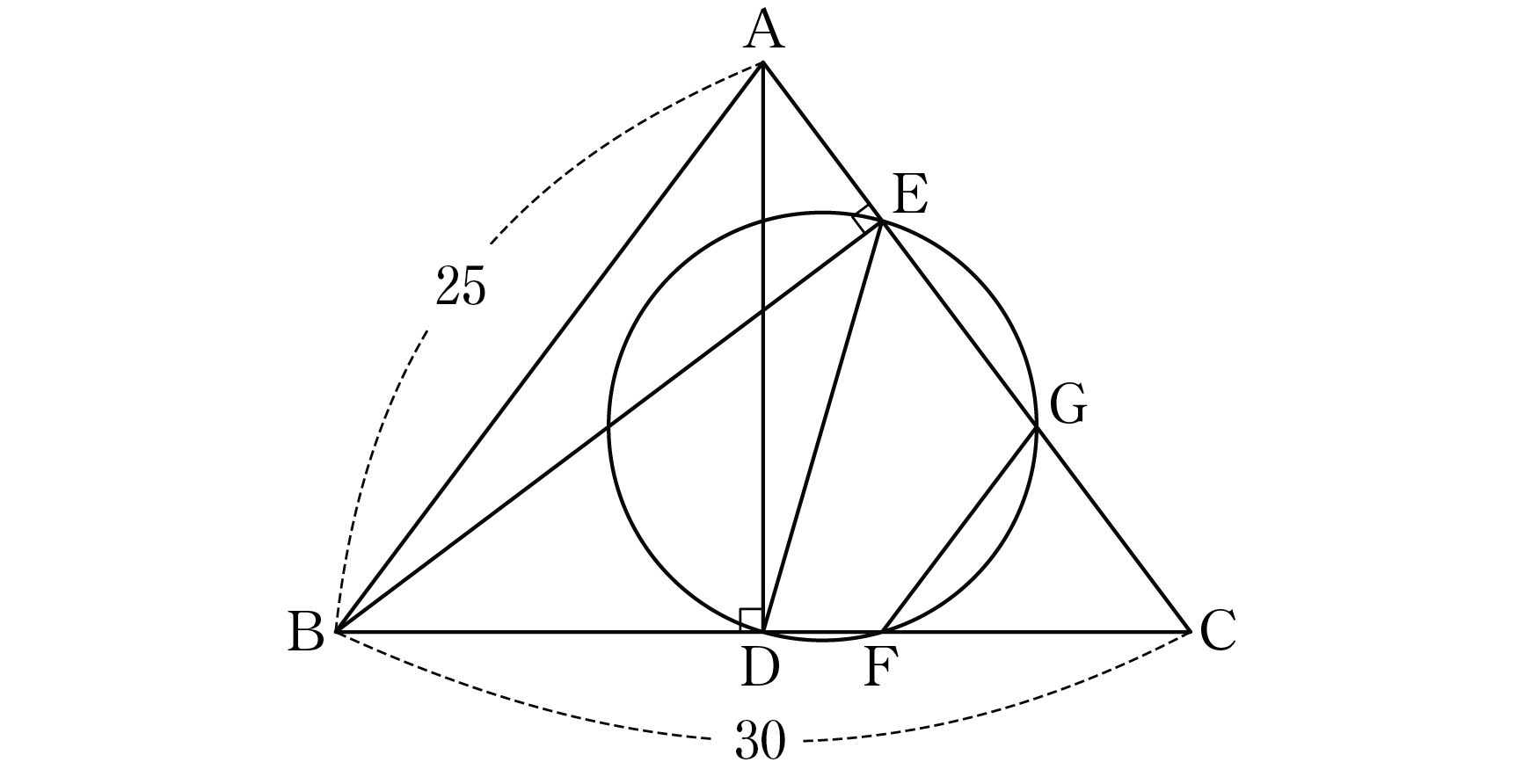
그림과 같이 AB=AC=25\displaystyle \overline{\mathrm{AB}} = \overline{\mathrm{AC}} = 25, BC=30\displaystyle \mathrm{\overline{BC}} = 30인 삼각형 ABC\mathrm{ABC}가 있다. 점 A\mathrm{A}에서 변 BC\mathrm{BC}에 내린 수선의 발을 D\mathrm{D}라 하고, 점 B\mathrm{B}에서 변 AC\mathrm{AC}에 내린 수선의 발을 E\mathrm{E}라 하자. 선분 DE\mathrm{DE}를 지름으로 하는 원이 변 BC\mathrm{BC}와 만나는 점 중 D\mathrm{D}가 아닌 점을 F\mathrm{F}, 변 AC\mathrm{AC}와 만나는 점 중 E\mathrm{E}가 아닌 점을 G\mathrm{G}라 하자. 삼각형 GFC\mathrm{GFC}의 둘레의 길이가 qp\displaystyle \frac{q}{p}일 때, p+qp + q의 값을 구하시오. (단, ppqq는 서로소인 자연수이다.) [4점]

정답 보기
149

자료 내려받기

아직 올라온 파일이 없습니다.

해설

[출제의도] 삼각형의 닮음과 원의 성질을 이용하여 주어진 문제를 해결한다.

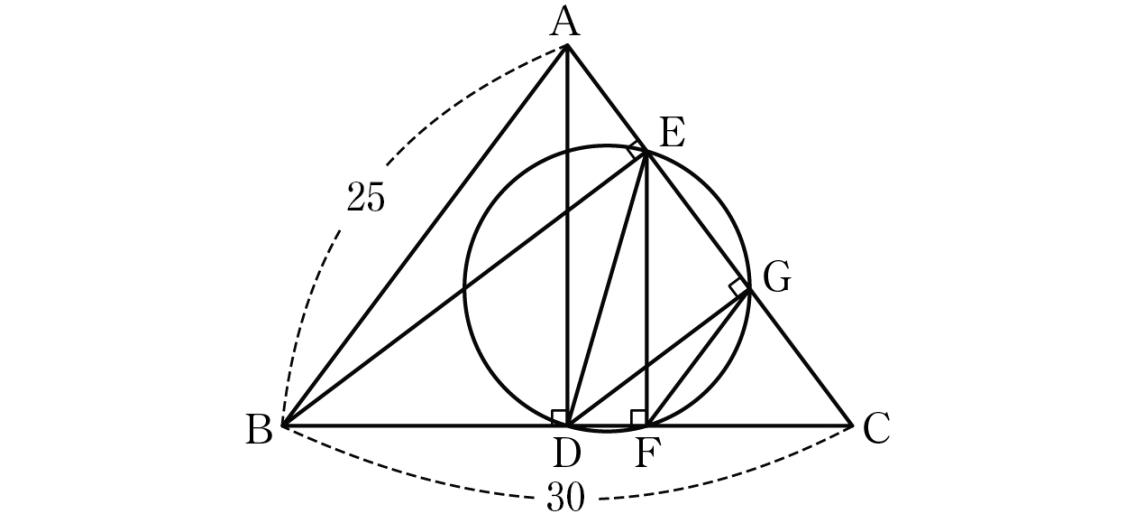
AB=AC=25\displaystyle \overline{\mathrm{AB}} = \overline{\mathrm{AC}} = 25이므로 삼각형 ABC\mathrm{ABC}는 이등변삼각형이다. 점 D\mathrm{D}가 점 A\mathrm{A}에서 변 BC\mathrm{BC}에 내린 수선의 발이므로 BC=30\displaystyle \mathrm{\overline{BC}} = 30에서 BD=DC=15\displaystyle \mathrm{\overline{BD}} = \mathrm{\overline{DC}} = 15 두 삼각형 ADC\mathrm{ADC}, BEC\mathrm{BEC}에서 C\mathrm{\angle} C가 공통이고 ADC=BEC=90\angle \mathrm{ADC} = \angle BEC = 90 ^\circ이므로 ADCBEC\triangle \mathrm{ADC} \backsim \triangle \mathrm{BEC}이다. AC:CD=BC:CE\displaystyle \mathrm{\overline{AC}} : \overline{CD} = \overline{BC} : \overline{CE}이고 25:15=30:CE\displaystyle 25 : 15 = 30 : \mathrm{\overline{CE}}이므로 CE=18\displaystyle \mathrm{\overline{CE}} = 18이다. DE\displaystyle \mathrm{\overline{DE}}가 원의 지름이므로 DGE=90\angle \mathrm{DGE} = 90 ^\circ BEC=DGC=90\angle \mathrm{BEC} = \angle DGC = 90 ^\circ이므로 DGBE\displaystyle \mathrm{\overline{DG}} \parallel \mathrm{\overline{BE}}D\mathrm{D}가 변 BC\mathrm{BC}의 중점이므로 EG=GC=9\displaystyle \mathrm{\overline{EG}} = \mathrm{\overline{GC}} = 9 DE\displaystyle \mathrm{\overline{DE}}가 원의 지름이므로 EFD=90\angle \mathrm{EFD} = 90 ^\circ가 되어 삼각형 EFC\mathrm{EFC}는 직각삼각형이다. 점 G\mathrm{G}는 선분 EC\mathrm{EC}의 중점이므로 직각삼각형 EFC\mathrm{EFC}의 외심이다. 따라서 FG=GC=9\displaystyle \mathrm{\overline{FG}} = \overline{GC} = 9 두 삼각형 ADC\mathrm{ADC}, EFC\mathrm{EFC}에서 C\mathrm{\angle} C는 공통이고 ADC=EFC=90\mathrm{\angle} ADC = \angle EFC = 90 ^\circ이므로 ADCEFC\triangle \mathrm{ADC} \backsim \triangle \mathrm{EFC}이다. CA:CE=CD:CF\displaystyle \mathrm{\overline{CA}} : \overline{CE} = \overline{CD} : \overline{CF}이고 25:18=15:CF\displaystyle 25 : 18 = 15 : \mathrm{\overline{CF}}이므로 CF=545\displaystyle \mathrm{\overline{CF}} = \frac{54}{5}이다. 그러므로 삼각형 GFC\mathrm{GFC}의 둘레의 길이는 GF+FC+CG\displaystyle \mathrm{\overline{GF}} + \overline{FC} + \overline{CG}=9+545+9\displaystyle = 9 + \frac{54}{5} + 9=1445\displaystyle = \frac{144}{5}이다. 따라서 p=5p = 5, q=144q = 144이므로 p+q=149p + q = 149 [다른 풀이]

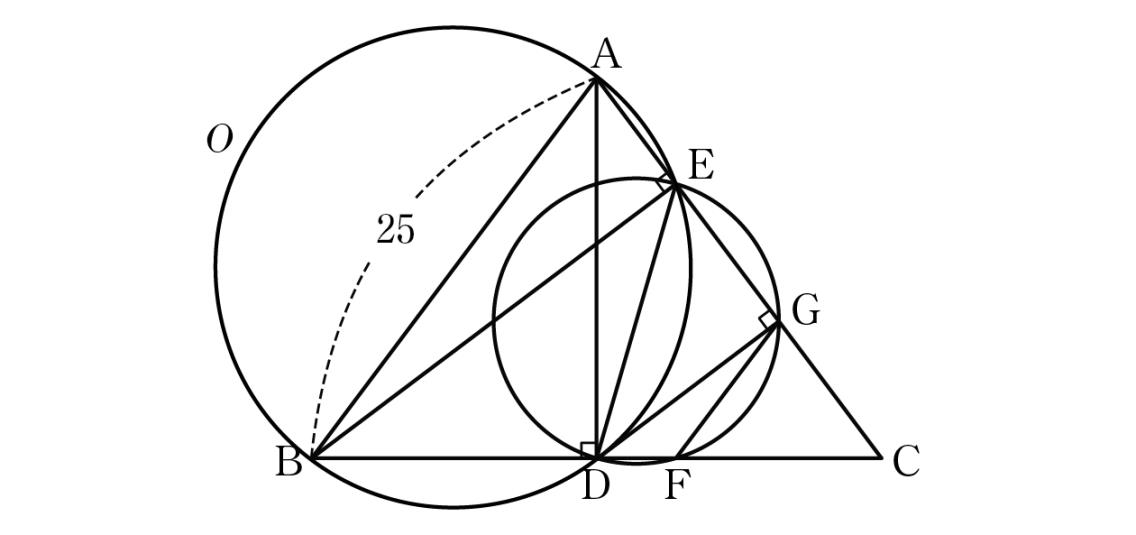
AB=AC=25\displaystyle \overline{\mathrm{AB}} = \overline{\mathrm{AC}} = 25이므로 삼각형 ABC\mathrm{ABC}는 이등변삼각형이다. 점 D\mathrm{D}가 점 A\mathrm{A}에서 변 BC\mathrm{BC}에 내린 수선의 발이므로 BC=30\displaystyle \mathrm{\overline{BC}} = 30에서 BD=DC=15\displaystyle \mathrm{\overline{BD}} = \mathrm{\overline{DC}} = 15 직각삼각형 ABD\mathrm{ABD}에서 피타고라스 정리에 의하여 AD\displaystyle \mathrm{\overline{AD}}=AB2BD2\displaystyle = \sqrt{\mathrm{\overline{AB}} ^{2} - {\overline{BD}} ^{2}}=252152\displaystyle = \sqrt{25 ^{2} - 15 ^{2}}=20= 20 삼각형 ABC\mathrm{ABC}의 넓이에서 12×BC×AD=12×AC×BE\displaystyle \frac{1}{2} \times \mathrm{\overline{BC}} \times {\overline{AD}} = \frac{1}{2} \times {\overline{AC}} \times {\overline{BE}} 12×30×20=12×25×BE\displaystyle \frac{1}{2} \times 30 \times 20 = \frac{1}{2} \times 25 \times {\overline{\mathrm{BE}}} BE=24\displaystyle {\overline{\mathrm{BE}}} = 24 직각삼각형 BCE\mathrm{BCE}에서 피타고라스 정리에 의하여 EC\displaystyle \mathrm{\overline{EC}}=BC2BE2\displaystyle = \sqrt{\mathrm{\overline{BC}} ^{2} - {\overline{BE}} ^{2}}=302242\displaystyle = \sqrt{30 ^{2} - 24 ^{2}}=18= 18 선분 DE\mathrm{DE}가 원의 지름이므로 DGE=90\angle \mathrm{DGE} = 90 ^\circ BEC=DGC=90\mathrm{\angle} BEC = \angle DGC = 90 ^\circ이므로 DGBE\displaystyle \mathrm{\overline{DG}} \parallel \mathrm{\overline{BE}} BD=DC\displaystyle \mathrm{\overline{BD}} = \mathrm{\overline{DC}}이므로 삼각형의 중점연결정리에 의하여 EG=GC=9\displaystyle \mathrm{\overline{EG}} = \mathrm{\overline{GC}} = 9 조건에 의해 사각형 EDFG\mathrm{EDFG}는 원에 내접한다. 원에 내접하는 사각형에서 두 대각의 합은 180180 ^\circ이므로 FGE+EDF=180\mathrm{\angle} FGE + \angle EDF = 180 ^\circ 또, FGE+CGF=180\mathrm{\angle} FGE + \angle CGF = 180 ^\circ이므로 FGE+EDF\mathrm{\angle} FGE + \angle EDF=FGE+CGF\mathrm{=} \angle FGE + \angle CGF EDF=CGF\mathrm{\angle} EDF = \angle CGF \cdots \cdots \text{㉠} 이때 GCF\mathrm{\angle} GCF는 공통이므로 두 삼각형 CGF\mathrm{CGF}, CDE\mathrm{CDE}는 닮음이다. 삼각형 ABD\mathrm{ABD}의 외접원을 OO라 하자. AEB=90\mathrm{\angle} AEB = 90 ^\circ이므로 점 E\mathrm{E}는 원 OO 위에 있다. 즉, 사각형 ABDE\mathrm{ABDE}는 원 OO에 내접한다. 원에 내접하는 사각형에서 두 대각의 합은 180180 ^\circ이므로 BAE+BDE=180\mathrm{\angle} BAE + \angle BDE = 180 ^\circ 또, BDE+CDE=180\mathrm{\angle} BDE + \angle CDE = 180 ^\circ이므로 BAE+BDE\mathrm{\angle} BAE + \angle BDE=BDE+CDE\mathrm{=} \angle BDE + \angle CDE BAE=CDE\mathrm{\angle} BAE = \angle CDE \cdots \cdots \text{㉡} 두 각 CDE\mathrm{CDE}, EDF\mathrm{EDF}는 같은 각이므로 \text{㉠}, \text{㉡}에서 BAE=CGF\mathrm{\angle} BAE = \angle CGF 두 각 BAC\mathrm{BAC}, BAE\mathrm{BAE}는 같은 각이므로 BAC=CGF\mathrm{\angle} BAC = \angle CGF 삼각형 ABC\mathrm{ABC}와 삼각형 GFC\mathrm{GFC}에서 C\mathrm{\angle} C는 공통이고 BAC=FGC\mathrm{\angle} BAC = \angle FGC이므로 ABCGFC\triangle \mathrm{ABC} \backsim \triangle \mathrm{GFC} 삼각형 ABC\mathrm{ABC}가 이등변삼각형이므로 삼각형 GFC\mathrm{GFC}도 이등변삼각형이다. 그러므로 GF=GC=9\displaystyle \mathrm{\overline{GF}} = \overline{GC} = 9 AC:GC=BC:FC\displaystyle \mathrm{\overline{AC}} : \overline{GC} = \overline{BC} : \overline{FC}에서 25:9=30:FC\displaystyle 25 : 9 = \mathrm{30} : \overline{FC}이므로 FC=545\displaystyle {\overline{\mathrm{FC}}} = \frac{54}{5} 그러므로 삼각형 GFC\mathrm{GFC}의 둘레의 길이는 GF+FC+CG\displaystyle \mathrm{\overline{GF}} + \overline{FC} + \overline{CG}=9+545+9\displaystyle = 9 + \frac{54}{5} + 9=1445\displaystyle = \frac{144}{5}이다. 따라서 p=5p = 5, q=144q = 144이므로 p+q=149p + q = 149

태그

비슷한 문제 더 보기

← 전체 문제 목록으로