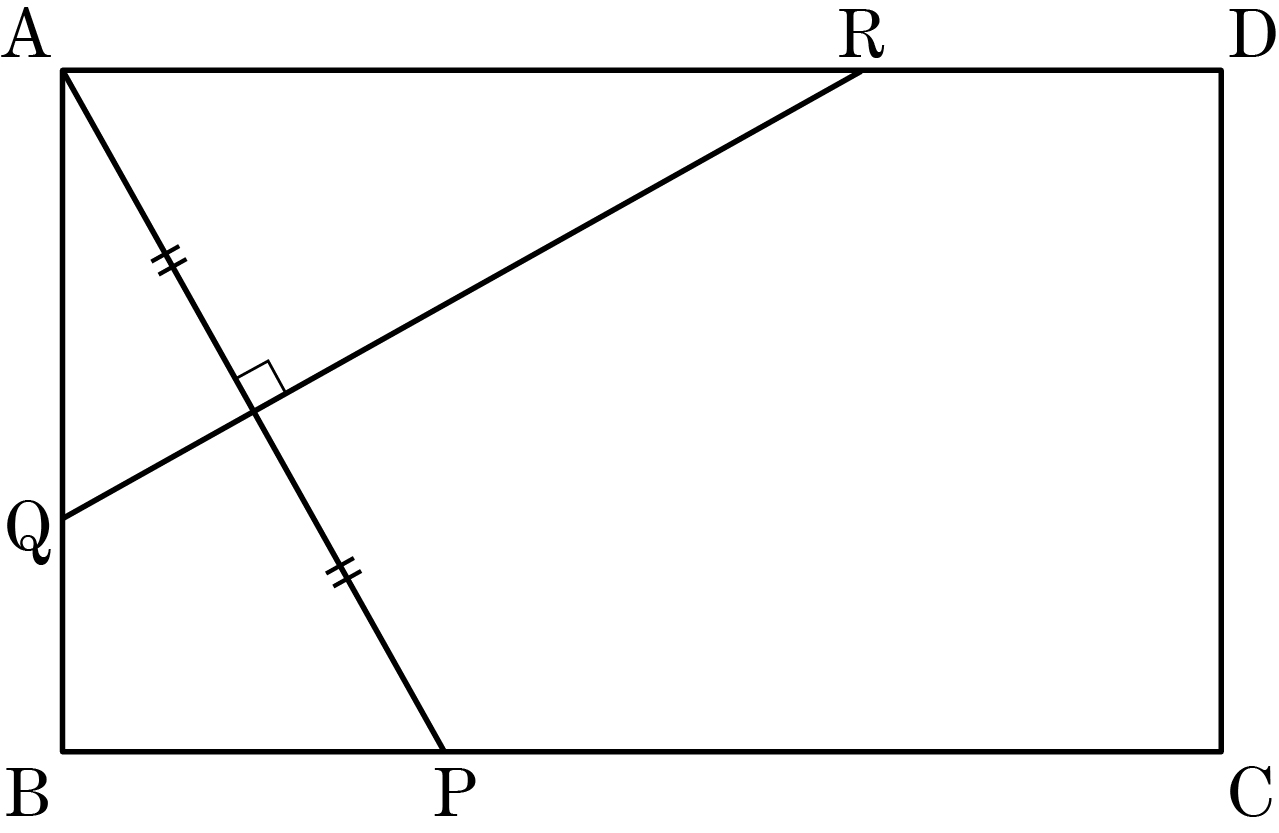
[출제의도] 미분법을 이용하여 최솟값 문제를 해결한다.
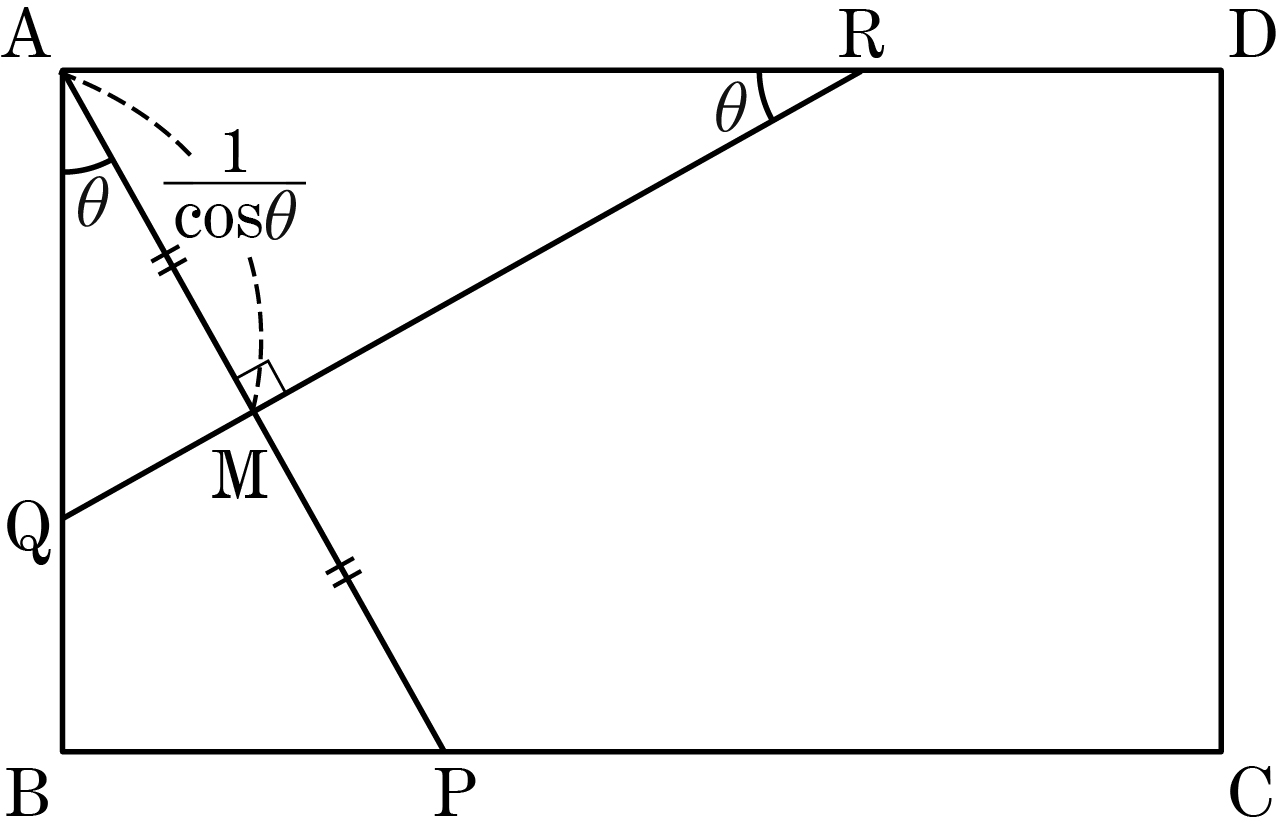
선분 A P \mathrm{AP} AP M \mathrm{M} M ∠ B A P = θ \angle \mathrm{BAP} = \mathit{\theta} ∠ BAP = θ ( 0 < θ ≤ π 3 ) \displaystyle \left( 0 < \theta \leq \frac{\pi}{3} \right) ( 0 < θ ≤ 3 π ) A P ‾ = 2 cos θ \displaystyle \overline{\mathrm{AP}} = \frac{2}{\cos \theta} AP = cos θ 2 A M ‾ = 1 2 A P ‾ = 1 cos θ \displaystyle \overline{\mathrm{AM}} = \frac{1}{2} \overline{\mathrm{A} P} = \frac{1}{\cos \theta} AM = 2 1 A P = cos θ 1 A Q ‾ = A M ‾ cos θ = 1 cos 2 θ \displaystyle \overline{\mathrm{AQ}} = \frac{\overline{\mathrm{AM}}}{\cos \theta} = \frac{1}{\cos ^{2} \theta} AQ = cos θ AM = cos 2 θ 1 A Q R \mathrm{AQR} AQR A M ‾ \displaystyle \overline{\mathrm{AM}} AM ⊥ \perp ⊥ Q R ‾ \displaystyle \overline{\mathrm{QR}} QR ∠ A R Q = θ \angle \mathrm{ARQ} = \mathit{\theta} ∠ ARQ = θ Q R ‾ = A Q ‾ sin θ = 1 cos 2 θ sin θ \displaystyle \overline{\mathrm{QR}} = \frac{\overline{\mathrm{AQ}}}{\sin \theta} = \frac{1}{\cos ^{2} \theta \sin \theta} QR = sin θ AQ = cos 2 θ sin θ 1 = 1 sin θ − sin 3 θ \displaystyle = \frac{1}{\sin \theta - \sin ^{3} \theta} = sin θ − sin 3 θ 1 sin θ = t \sin \theta = t sin θ = t Q R ‾ = 1 t − t 3 \displaystyle \overline{\mathrm{QR}} = \frac{1}{t - t ^{3}} QR = t − t 3 1 f ( t ) = f ( t ) = f ( t ) = t − t 3 t - t ^{3} t − t 3 ( 0 < t ≤ 3 2 ) \displaystyle \left( 0 < t \leq \frac{\sqrt{3}}{2} \right) ( 0 < t ≤ 2 3 ) f ′ ( t ) = 1 − 3 t 2 = 0 f' ( t ) = 1 - 3 t ^{2} = 0 f ′ ( t ) = 1 − 3 t 2 = 0 t = 3 3 \displaystyle t = \frac{\sqrt{3}}{3} t = 3 3 t = − 3 3 \displaystyle t = - \frac{\sqrt{3}}{3} t = − 3 3 f ( t ) f ( t ) f ( t ) t = 3 3 \displaystyle t = \frac{\sqrt{3}}{3} t = 3 3 f ( 3 3 ) \displaystyle f \left( \frac{\sqrt{3}}{3} \right) f ( 3 3 ) Q R ‾ = 1 f ( t ) ≥ 1 f ( 3 3 ) \displaystyle \overline{\mathrm{QR}} = \frac{1}{f ( t )} \geq \frac{1}{f \left( \frac{\sqrt{3}}{3} \right)} QR = f ( t ) 1 ≥ f ( 3 3 ) 1 = 3 3 2 \displaystyle = \frac{3 \sqrt{3}}{2} = 2 3 3 4 k 2 = 4 × ( 3 3 2 ) 2 = 27 \displaystyle 4 k ^{2} = 4 \times \left( \frac{3 \sqrt{3}}{2} \right) ^{2} = 27 4 k 2 = 4 × ( 2 3 3 ) 2 = 27 A Q ‾ = x \displaystyle \overline{\mathrm{A} Q} = x A Q = x A Q ‾ = Q P ‾ \displaystyle \overline{\mathrm{A} Q} = \overline{\mathrm{Q} P} A Q = Q P = x = x = x B P ‾ = x 2 − ( 2 − x ) 2 = 4 x − 4 \displaystyle \overline{\mathrm{B} P} = \sqrt{x ^{2} - \left( 2 - x \right) ^{2}} = \sqrt{4 x - 4} B P = x 2 − ( 2 − x ) 2 = 4 x − 4 = 2 x − 1 \displaystyle = 2 \sqrt{x - 1} = 2 x − 1 A P ‾ = 2 2 + ( 4 x − 4 ) = 2 x \displaystyle \overline{\mathrm{A} P} = \sqrt{2 ^{2} + ( 4 x - 4 )} = 2 \sqrt{x} A P = 2 2 + ( 4 x − 4 ) = 2 x A B P \mathrm{A} BP A B P R A Q \mathrm{R} AQ R A Q A Q ‾ : Q R ‾ = B P ‾ : P A ‾ \displaystyle \overline{\mathrm{AQ}} : \overline{\mathrm{QR}} = \overline{\mathrm{BP}} : \overline{\mathrm{PA}} AQ : QR = BP : PA Q R ‾ = A Q ‾ ⋅ P A ‾ B P ‾ = 2 x x 2 x − 1 \displaystyle \overline{\mathrm{QR}} = \frac{\overline{\mathrm{AQ}} \cdot \overline{\mathrm{PA}}}{\overline{\mathrm{BP}}} = \frac{2 x \sqrt{x}}{2 \sqrt{x - 1}} QR = BP AQ ⋅ PA = 2 x − 1 2 x x = x x x − 1 \displaystyle = \frac{x \sqrt{x}}{\sqrt{x - 1}} = x − 1 x x Q R ‾ 2 = f ( x ) \displaystyle {\overline{\mathrm{QR}}} ^{2} = f ( x ) QR 2 = f ( x ) f ( x ) = x 3 x − 1 \displaystyle f ( x ) = \frac{x ^{3}}{x - 1} f ( x ) = x − 1 x 3 1 < x ≤ 4 1 < x \leq 4 1 < x ≤ 4 f ′ ( x ) = 3 x 2 ( x − 1 ) − x 3 ( x − 1 ) 2 \displaystyle f' ( x ) = \frac{3 x ^{2} ( x - 1 ) - x ^{3}}{( x - 1 ) ^{2}} f ′ ( x ) = ( x − 1 ) 2 3 x 2 ( x − 1 ) − x 3 = x 2 ( 2 x − 3 ) ( x − 1 ) 2 \displaystyle = \frac{x ^{2} ( 2 x - 3 )}{( x - 1 ) ^{2}} = ( x − 1 ) 2 x 2 ( 2 x − 3 ) f ( x ) f ( x ) f ( x )
x x x ( 1 ) ( 1 ) ( 1 ) … 3 2 \displaystyle \frac{3}{2} 2 3 … 4 4 4 f ′ ( x ) f' ( x ) f ′ ( x ) − - − 0 0 0 + + + f ( x ) f ( x ) f ( x ) ↘ 27 4 \displaystyle \frac{27}{4} 4 27 ↗ 64 3 \displaystyle \frac{64}{3} 3 64
∴ 4 k 2 = 4 f ( 3 2 ) = 27 \displaystyle 4 k ^{2} = 4 f \left( \frac{3}{2} \right) = 27 4 k 2 = 4 f ( 2 3 ) = 27