중학중학 미분류수능 기출발전 문제 (3점 후반~4점 초반)

외접원 현의 길이 빈칸

문제

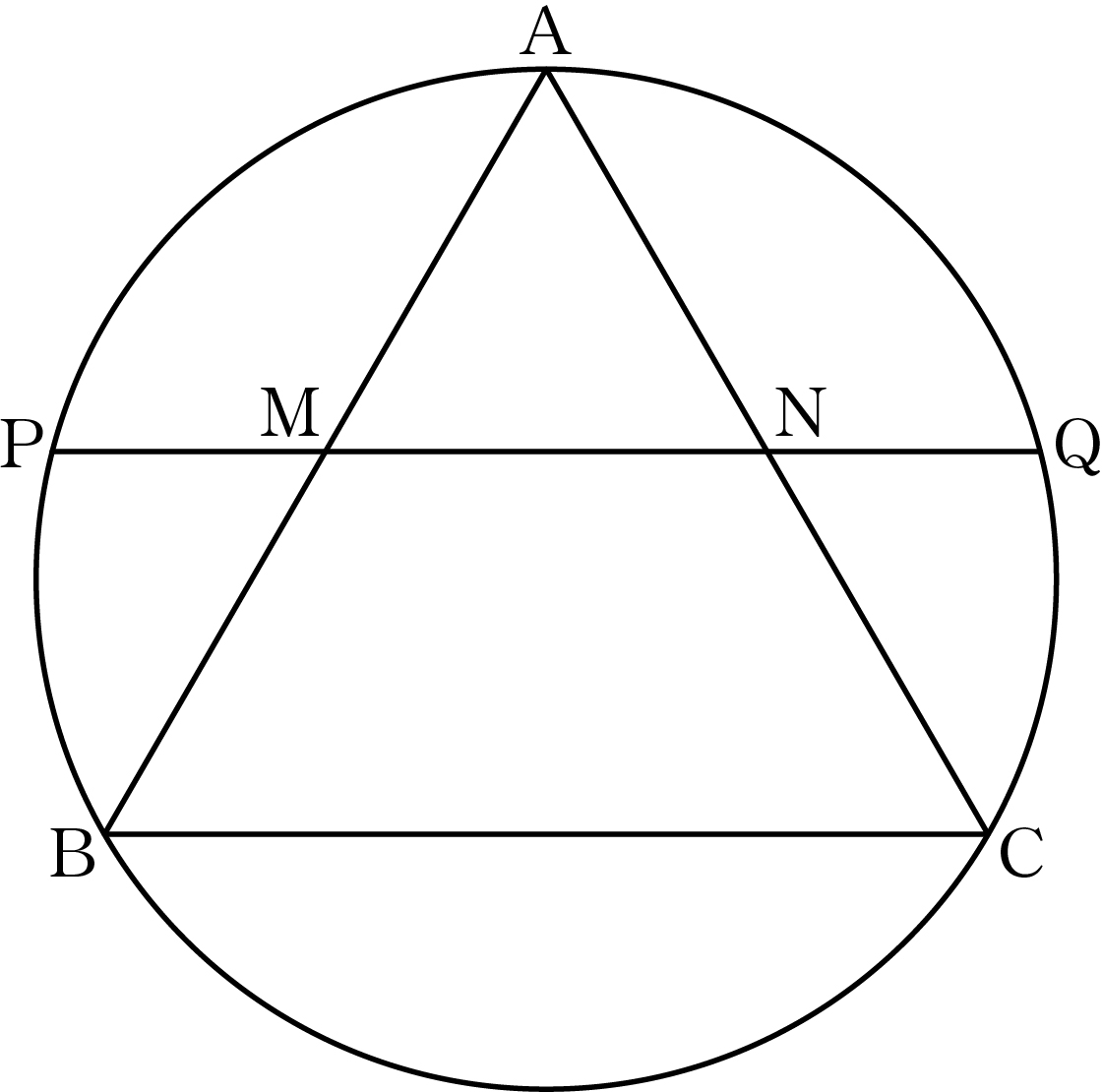
한 변의 길이가 66인 정삼각형 ABC\mathrm{ABC}에서 두 변 AB\mathrm{AB}AC\mathrm{AC}의 중점을 각각 M\mathrm{M}, N\mathrm{N}이라 하자. 선분 MN\mathrm{MN}의 연장선이 삼각형 ABC\mathrm{ABC}의 외접원과 만나는 두 점 중에서 점 M\mathrm{M}에 가까운 점을 P\mathrm{P}라 하고 다른 한 점을 Q\mathrm{Q}라 하자.

다음은 선분 PQ\mathrm{PQ}의 길이를 구하는 과정이다.

두 점 M\mathrm{M}, N\mathrm{N}이 각각 두 변 AB\mathrm{AB}, AC\mathrm{AC}의 중점이므로 MN=()\displaystyle {\overline{\mathrm{MN}}} = {\square {( \text{가} ) ^{}}} PM=x\displaystyle {\overline{\mathrm{PM}}} = x라 하면 삼각형 ABC\mathrm{ABC}가 정삼각형이므로 NQ=PM=x\displaystyle {\overline{\mathrm{NQ}}} = {\overline{\mathrm{PM}}} = x 이다. 한편, PAC=PQC\angle \mathrm{PAC} = \angle \mathrm{PQC}이고 ANP=QNC\angle \mathrm{ANP} = \angle \mathrm{QNC}이므로 APNQCN\mathrm{\triangle} APN \backsim \triangle QCN 이다. 따라서 3:=x:33 : {\square {{}^{}}} = x : 3 이다. 그러므로 PQ=()\displaystyle \begin{aligned} {\overline{\mathrm{PQ}}} & = {\square {( \text{나} )}} \end{aligned} 이다.

위의 (가), (나)에 알맞은 수를 각각 aa, bb라 할 때, ba\displaystyle \frac{b}{a}의 값은? [4점] 5\displaystyle \sqrt{5}453\displaystyle \frac{4 \sqrt{5}}{3}553\displaystyle \frac{5 \sqrt{5}}{3}25\displaystyle 2 \sqrt{5}753\displaystyle \frac{7 \sqrt{5}}{3}

정답 보기

자료 내려받기

아직 올라온 파일이 없습니다.

해설

[출제의도] 원주각의 성질을 이용하여 선분의 길이를 구하는 과정을 추론한다.

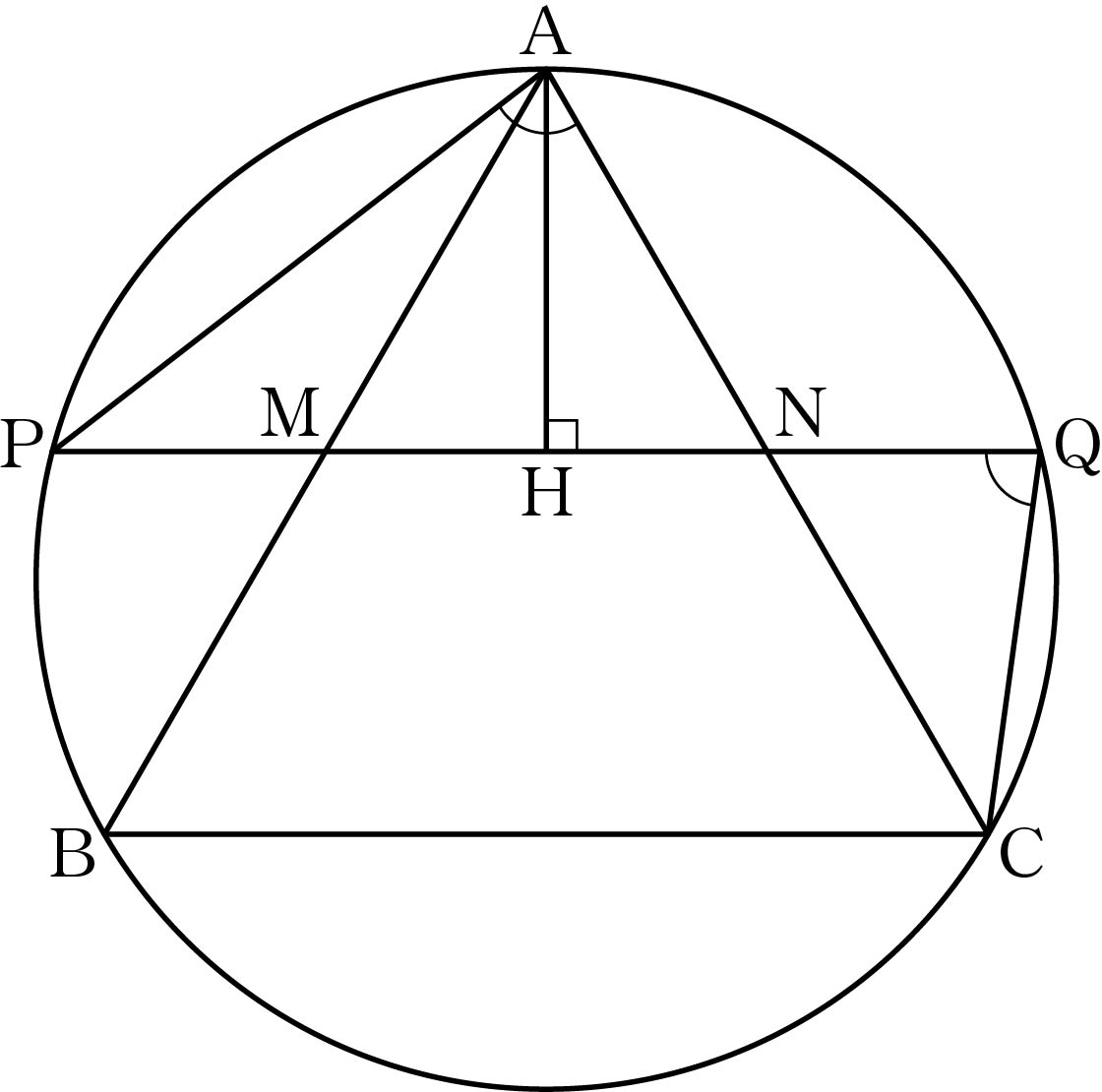
두 점 M\mathrm{M}, N\mathrm{N}이 각각 두 선분 AB\mathrm{AB}, AC\mathrm{AC}의 중점이므로 MN=12BC=3\displaystyle {\overline{\mathrm{MN}}} = \frac{1}{2} {\overline{\mathrm{BC}}} = {\square {3}} PM=x\displaystyle {\overline{\mathrm{PM}}} = x라 하자. 점 A\mathrm{A}에서 선분 MN\mathrm{MN}에 내린 수선의 발을 H\mathrm{H}라 하자. 삼각형 ABC\mathrm{ABC}가 정삼각형이므로 직선 AH\mathrm{AH}는 원의 중심을 지나고 원의 성질에 의해 PH=HQ\displaystyle {\overline{\mathrm{PH}}} = {\overline{\mathrm{HQ}}} 한편 MH=HN\displaystyle {\overline{\mathrm{MH}}} = {\overline{\mathrm{HN}}}이므로 NQ=PM=x\displaystyle {\overline{\mathrm{NQ}}} = {\overline{\mathrm{PM}}} = xPC\mathrm{PC}에 대한 원주각의 크기는 일정하므로 PAC=PQC\angle \mathrm{PAC} = \angle \mathrm{PQC}이고 맞꼭지각의 크기가 같으므로 ANP=QNC\angle \mathrm{ANP} = \angle \mathrm{QNC}이다. 따라서 APNQCN\mathrm{\triangle} APN \backsim \triangle QCN이므로 AN:PN=QN:CN\displaystyle {\overline{\mathrm{AN}}} : {\overline{\mathrm{PN}}} = {\overline{\mathrm{QN}}} : {\overline{\mathrm{CN}}} 이때 AN=CN=12AC=3\displaystyle {\overline{\mathrm{AN}}} = {\overline{\mathrm{CN}}} = \frac{1}{2} {\overline{\mathrm{AC}}} = 3이므로 3:x+3=x:33 : {\square {x + 3}} = x : 3 이다. x(x+3)=9x ( x + 3 ) = 9 x2+3x9=0x ^{2} + 3 x - 9 = 0 이차방정식의 근의 공식에 의하여 x=3±352\displaystyle x = \frac{- 3 \pm 3 \sqrt{5}}{2} x>0x > 0이므로 x=3+352\displaystyle x = \frac{- 3 + 3 \sqrt{5}}{2} 그러므로 PQ\displaystyle {\overline{\mathrm{PQ}}}=2PM+MN\displaystyle = 2 {\overline{\mathrm{PM}}} + {\overline{\mathrm{MN}}}=2x+3= 2 x + 3=2×3+352+3\displaystyle = 2 \times \frac{- 3 + 3 \sqrt{5}}{2} + 3 =3+35+3\displaystyle = - 3 + 3 \sqrt{5} + 3 =35\displaystyle = {\square {3 \sqrt{5}}} 따라서 a=3a = 3, b=35\displaystyle b = 3 \sqrt{5}이므로 ba\displaystyle \frac{b}{a}=353\displaystyle = \frac{3 \sqrt{5}}{3}=5\displaystyle = \sqrt{5}

태그

비슷한 문제 더 보기

← 전체 문제 목록으로