기하공간도형과 공간좌표수능 기출킬러 문제 (22·30번 수준)

정사각뿔 구와 정사영

문제

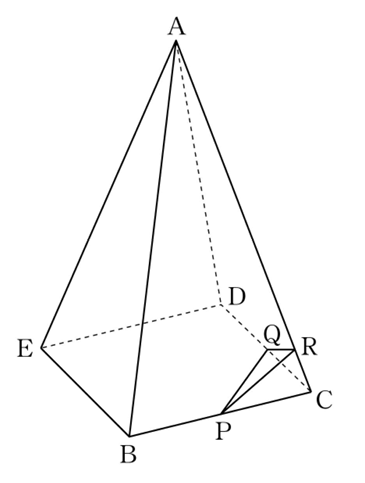
그림과 같이 한 변의 길이가 2\mathrm{2}인 정사각형을 밑면으로 하고 AB=AC=AD=AE=4\displaystyle {\overline{\mathrm{AB}}} = {\overline{\mathrm{AC}}} = {\overline{\mathrm{AD}}} = {\overline{\mathrm{AE}}} = 4인 정사각뿔 ABCDE\mathrm{A} \mathit{-} \mathrm{BCDE}가 있다. 두 선분 BC\mathrm{BC}, CD\mathrm{CD}의 중점을 각각 P\mathrm{P}, Q\mathrm{Q}라 하고, 선분 CA\mathrm{CA}1:71 : 7로 내분하는 점을 R\mathrm{R}이라 하자. 네 점 C\mathrm{C}, P\mathrm{P}, Q\mathrm{Q}, R\mathrm{R}을 모두 지나는 구 위의 점 중에서 직선 AB\mathrm{AB}와의 거리가 최소인 점을 S\mathrm{S}라 하자. 삼각형 ABS\mathrm{ABS}의 평면 BCD\mathrm{BCD} 위로의 정사영의 넓이가 p+q2\displaystyle p + q \sqrt{2}일 때, 60×(p+q)60 \times \left( p + q \right)의 값을 구하시오. (단, pp, qq는 유리수이다.) [4점]

정답 보기
20

자료 내려받기

아직 올라온 파일이 없습니다.

해설

RCP=ACP\angle \mathrm{RCP} = \mathit{\angle} \mathrm{ACP}이므로 cos(RCP)=14\displaystyle \cos \left( \angle \mathrm{RCP} \right) = \frac{1}{4} RC=12\displaystyle {\overline{\mathrm{RC}}} = \frac{1}{2}이므로 삼각형 RCP\mathrm{RCP}에서 코사인법칙에 의해 RP2\displaystyle {\overline{\mathrm{RP}}} ^{2}=RC2+PC22×RC×PC×cos(RCP)\displaystyle = {\overline{\mathrm{RC}}} ^{2} + {\overline{\mathrm{PC}}} ^{2} - 2 \times {\overline{\mathrm{RC}}} \times {\overline{\mathrm{PC}}} \times \cos \left( \angle \mathrm{RCP} \right) =(12)2+122×12×1×14=1\displaystyle = \left( \frac{1}{2} \right) ^{2} + 1 ^{2} - 2 \times \frac{1}{2} \times 1 \times \frac{1}{4} = 1 이므로 RP=1\displaystyle {\overline{\mathrm{RP}}} = 1, 마찬가지로 QR=1\displaystyle {\overline{\mathrm{QR}}} = 1 두 삼각형 PQC\mathrm{PQC}, PQR\mathrm{PQR}은 서로 합동이므로 PCQ=PRQ=π2\displaystyle \angle \mathrm{PCQ} = \mathit{\angle} \mathrm{PRQ} = \frac{\mathit{\pi}}{2}이고, 네 점 C\mathrm{C}, P\mathrm{P}, Q\mathrm{Q}, R\mathrm{R}을 모두 지나는 구를 SS라 하면 구 SS의 중심은 선분 PQ\mathrm{PQ}의 중점이고 구 SS의 반지름의 길이는 22\displaystyle \frac{\sqrt{2}}{2}이다. 구 SS의 중심을 O\mathrm{O}라 하자. 구 SS 위의 점 중 직선 AB\mathrm{AB}와의 거리가 최소인 점 S\mathrm{S}에 대하여 점 O\mathrm{O}에서 직선 AB\mathrm{AB}에 내린 수선의 발을 M\mathrm{M}이라 하면 삼각형 ABS\mathrm{ABS}의 넓이는 12×AB×(OM22)\displaystyle \frac{1}{2} \times {\overline{\mathrm{AB}}} \times \left( {\overline{\mathrm{OM}}} - \frac{\sqrt{2}}{2} \right)이다. 점 O\mathrm{O}에서 선분 BD\mathrm{BD}에 내린 수선의 발을 N\mathrm{N}이라 하면 N\mathrm{N}은 선분 BD\mathrm{BD}의 중점이다. AB=4\displaystyle {\overline{\mathrm{AB}}} = 4, BN=2\displaystyle {\overline{\mathrm{BN}}} = \sqrt{2}이므로 AN=AB2BN2=42(2)2=14\displaystyle {\overline{\mathrm{AN}}} = \sqrt{{\overline{\mathrm{AB}}} ^{2} - {\overline{\mathrm{BN}}} ^{2}} = \sqrt{4 ^{2} - \left( \sqrt{2} \right) ^{2}} = \sqrt{14} ON=22\displaystyle {\overline{\mathrm{ON}}} = \frac{\sqrt{2}}{2}이므로 OA=AN2+ON2=(14)2+(22)2=292\displaystyle {\overline{\mathrm{OA}}} = \sqrt{{\overline{\mathrm{AN}}} ^{2} + {\overline{\mathrm{ON}}} ^{2}} = \sqrt{\left( \sqrt{14} \right) ^{2} + \left( \frac{\sqrt{2}}{2} \right) ^{2}} = \sqrt{\frac{29}{2}} OB=BN2+ON2=(2)2+(22)2=52\displaystyle {\overline{\mathrm{OB}}} = \sqrt{{\overline{\mathrm{BN}}} ^{2} + {\overline{\mathrm{ON}}} ^{2}} = \sqrt{\left( \sqrt{2} \right) ^{2} + \left( \frac{\sqrt{2}}{2} \right) ^{2}} = \sqrt{\frac{5}{2}} 삼각형 OAB\mathrm{OAB}에서 코사인법칙에 의해 cos(OBA)\cos \left( \angle \mathrm{OBA} \right)=AB2+OB2OA22×AB×OB\displaystyle = \frac{{\overline{\mathrm{AB}}} ^{2} + {\overline{\mathrm{OB}}} ^{2} - {\overline{\mathrm{OA}}} ^{2}}{2 \times {\overline{\mathrm{AB}}} \times {\overline{\mathrm{OB}}}} =42+(52)2(292)22×4×52=110\displaystyle = \frac{4 ^{2} + \left( \sqrt{\frac{5}{2}} \right) ^{2} - \left( \sqrt{\frac{29}{2}} \right) ^{2}}{2 \times 4 \times \sqrt{\frac{5}{2}}} = \frac{1}{\sqrt{10}} 이므로 sin(OBA)=310\displaystyle \sin \left( \angle \mathrm{OBA} \right) = \frac{3}{\sqrt{10}} OM=OB×sin(OBA)=52×310=32\displaystyle {\overline{\mathrm{OM}}} = {\overline{\mathrm{OB}}} \times \sin \left( \angle \mathrm{OBA} \right) = \sqrt{\frac{5}{2}} \times \frac{3}{\sqrt{10}} = \frac{3}{2} 따라서 삼각형 ABS\mathrm{ABS}의 넓이는 12×AB×(OM22)\displaystyle \frac{1}{2} \times {\overline{\mathrm{AB}}} \times \left( {\overline{\mathrm{OM}}} - \frac{\sqrt{2}}{2} \right)=12×4×(3222)\displaystyle = \frac{1}{2} \times 4 \times \left( \frac{3}{2} - \frac{\sqrt{2}}{2} \right) =32\displaystyle = 3 - \sqrt{2} 삼각형 OAB\mathrm{OAB}의 넓이는 12×AB×OM=12×4×32=3\displaystyle \frac{1}{2} \times {\overline{\mathrm{AB}}} \times {\overline{\mathrm{OM}}} = \frac{1}{2} \times 4 \times \frac{3}{2} = 3 삼각형 OBN\mathrm{OBN}의 넓이는 12×BN×ON=12×2×22=12\displaystyle \frac{1}{2} \times {\overline{\mathrm{BN}}} \times {\overline{\mathrm{ON}}} = \frac{1}{2} \times \sqrt{2} \times \frac{\sqrt{2}}{2} = \frac{1}{2} 두 평면 OAB\mathrm{O} A BBCD\mathrm{BCD}가 이루는 각의 크기를 θ\theta라 하자. 삼각형 OAB\mathrm{OAB}의 평면 BCD\mathrm{BCD} 위로의 정사영은 삼각형 OBN\mathrm{OBN}이므로 3×cosθ=12\displaystyle 3 \times \cos \theta = \frac{1}{2}, cosθ=16\displaystyle \cos \theta = \frac{1}{6} 두 평면 ABS\mathrm{ABS}BCD\mathrm{BCD}가 이루는 각의 크기는 두 평면 OAB\mathrm{OAB}BCD\mathrm{BCD}가 이루는 각의 크기와 같으므로 삼각형 ABS\mathrm{ABS}의 평면 BCD\mathrm{BCD} 위로의 정사영의 넓이는 (32)×cosθ=(32)×16=1226\displaystyle \left( 3 - \sqrt{2} \right) \times \cos \theta = \left( 3 - \sqrt{2} \right) \times \frac{1}{6} = \frac{1}{2} - \frac{\sqrt{2}}{6} 따라서 p=12\displaystyle p = \frac{1}{2}, q=16\displaystyle q = - \frac{1}{6}이므로 60×(p+q)=60×(1216)=60×13=20\displaystyle 60 \times \left( p + q \right) = 60 \times \left( \frac{1}{2} - \frac{1}{6} \right) = 60 \times \frac{1}{3} = 20

태그

비슷한 문제 더 보기

← 전체 문제 목록으로