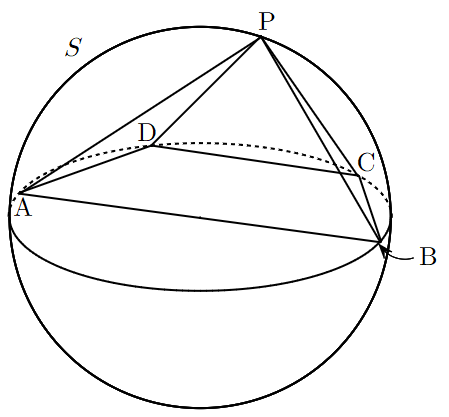
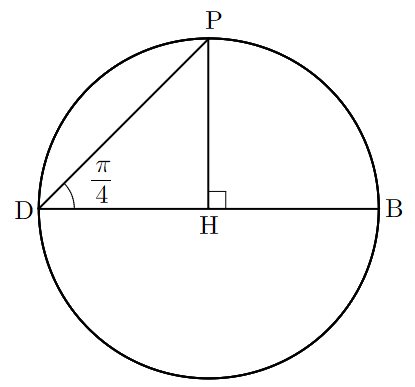
∠ A D B = π 2 \displaystyle \angle {\mathrm{ADB}} = \frac{\pi}{2} ∠ ADB = 2 π A B ‾ = 10 5 \displaystyle {\overline{\mathrm{AB}}} = 10 \sqrt{5} AB = 10 5 A D ‾ = 10 \displaystyle {\overline{\mathrm{AD}}} = 10 AD = 10 B D ‾ = 20 \displaystyle {\overline{\mathrm{BD}}} = 20 BD = 20 P {\mathrm{P}} P α \alpha α H {\mathrm{H}} H P {\mathrm{P}} P D {\mathrm{D}} D H {\mathrm{H}} H B {\mathrm{B}} B P H ‾ ⊥ α \displaystyle {\overline{\mathrm{PH}}} \perp \alpha PH ⊥ α B D ‾ ⊥ A D ‾ \displaystyle {\overline{\mathrm{BD}}} \perp {\overline{\mathrm{AD}}} BD ⊥ AD P D ‾ ⊥ A D ‾ \displaystyle {\overline{\mathrm{PD}}} \perp {\overline{\mathrm{AD}}} PD ⊥ AD S S S P B D {\mathrm{PBD}} PBD B D {\mathrm{BD}} BD ∠ P D H = π 4 \displaystyle \angle {\mathrm{PDH}} = \frac{\pi}{4} ∠ PDH = 4 π D H ‾ = P H ‾ = B H ‾ = 10 \displaystyle {\overline{\mathrm{DH}}} = {\overline{\mathrm{PH}}} = {\overline{\mathrm{BH}}} = 10 DH = PH = BH = 10 P B ‾ = 10 2 \displaystyle {\overline{\mathrm{PB}}} = 10 \sqrt{2} PB = 10 2
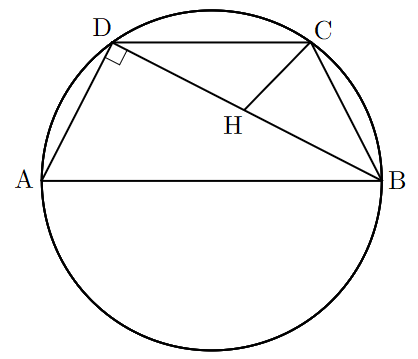
삼각형 B D A {\mathrm{BDA}} BDA cos ( ∠ D A B ) = A D ‾ A B ‾ = 5 5 \displaystyle \cos \left( \angle {\mathrm{DAB}} \right) = \frac{{\overline{\mathrm{AD}}}}{{\overline{\mathrm{AB}}}} = \frac{\sqrt{5}}{5} cos ( ∠ DAB ) = AB AD = 5 5 A B C D {\mathrm{ABCD}} ABCD C D ‾ = 10 5 − 2 × A D ‾ × cos ( ∠ D A B ) = 6 5 \displaystyle {\overline{\mathrm{CD}}} = 10 \sqrt{5} - 2 \times {\overline{\mathrm{AD}}} \times \cos \left( \angle {\mathrm{DAB}} \right) = 6 \sqrt{5} CD = 10 5 − 2 × AD × cos ( ∠ DAB ) = 6 5
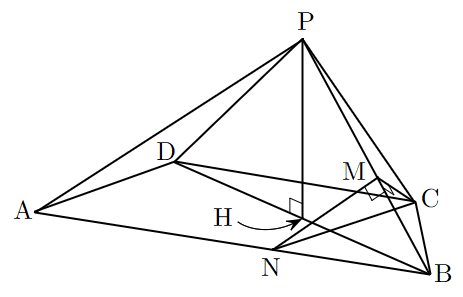
∠ B D C = ∠ A B D \angle {\mathrm{BDC}} = \angle {\mathrm{ABD}} ∠ BDC = ∠ ABD cos ( ∠ B D C ) = cos ( ∠ A B D ) = B D ‾ A B ‾ = 2 5 5 \displaystyle \cos \left( \angle {\mathrm{BDC}} \right) = \cos \left( \angle {\mathrm{ABD}} \right) = \frac{{\overline{\mathrm{BD}}}}{{\overline{\mathrm{AB}}}} = \frac{2 \sqrt{5}}{5} cos ( ∠ BDC ) = cos ( ∠ ABD ) = AB BD = 5 2 5 D H C {\mathrm{DHC}} DHC C H ‾ 2 \displaystyle {\overline{\mathrm{CH}}} ^{2} CH 2 = D H ‾ 2 + D C ‾ 2 − 2 × D H ‾ × D C ‾ × cos ( ∠ H D C ) \displaystyle = {\overline{\mathrm{DH}}} ^{2} + {\overline{\mathrm{DC}}} ^{2} - 2 \times {\overline{\mathrm{DH}}} \times {\overline{\mathrm{DC}}} \times \cos \left( \angle {\mathrm{HDC}} \right) = DH 2 + DC 2 − 2 × DH × DC × cos ( ∠ HDC ) = 10 2 + ( 6 5 ) 2 − 2 × 10 × 6 5 × 2 5 5 = 40 \displaystyle = 10 ^{2} + \left( 6 \sqrt{5} \right) ^{2} - 2 \times 10 \times 6 \sqrt{5} \times \frac{2 \sqrt{5}}{5} = 40 = 1 0 2 + ( 6 5 ) 2 − 2 × 10 × 6 5 × 5 2 5 = 40 C H ‾ = 2 10 \displaystyle {\overline{\mathrm{CH}}} = 2 \sqrt{10} CH = 2 10 P H C {\mathrm{PHC}} PHC P C ‾ \displaystyle {\overline{\mathrm{PC}}} PC = P H ‾ 2 + C H ‾ 2 \displaystyle = \sqrt{{\overline{\mathrm{PH}}} ^{2} + {\overline{\mathrm{CH}}} ^{2}} = PH 2 + CH 2 = 10 2 + ( 2 10 ) 2 = 2 35 \displaystyle = \sqrt{10 ^{2} + \left( 2 \sqrt{10} \right) ^{2}} = 2 \sqrt{35} = 1 0 2 + ( 2 10 ) 2 = 2 35 C {\mathrm{C}} C P B {\mathrm{PB}} PB M {\mathrm{M}} M M {\mathrm{M}} M P B {\mathrm{PB}} PB A B {\mathrm{AB}} AB N {\mathrm{N}} N
평면 P A B {\mathrm{PAB}} PAB P B C {\mathrm{PBC}} PBC M N {\mathrm{MN}} MN M C {\mathrm{MC}} MC P B C {\mathrm{PBC}} PBC P C ‾ 2 − ( P B ‾ − M B ‾ ) 2 = B C ‾ 2 − M B ‾ 2 \displaystyle {\overline{\mathrm{PC}}} ^{2} - \left( {\overline{\mathrm{PB}}} - {\overline{{\mathrm{MB}}}} \right) ^{2} = {\overline{\mathrm{BC}}} ^{2} - {\overline{{\mathrm{MB}}}} ^{2} PC 2 − ( PB − MB ) 2 = BC 2 − MB 2 ( 2 35 ) 2 − ( 10 2 − M B ‾ ) 2 = 10 2 − M B ‾ 2 \displaystyle \left( 2 \sqrt{35} \right) ^{2} - \left( 10 \sqrt{2} - {\overline{{\mathrm{MB}}}} \right) ^{2} = 10 ^{2} - {\overline{{\mathrm{MB}}}} ^{2} ( 2 35 ) 2 − ( 10 2 − MB ) 2 = 1 0 2 − MB 2 M B ‾ = 4 2 \displaystyle {\overline{{\mathrm{MB}}}} = 4 \sqrt{2} MB = 4 2 C M ‾ \displaystyle {\overline{\mathrm{CM}}} CM = B C ‾ 2 − M B ‾ 2 \displaystyle = \sqrt{{\overline{\mathrm{BC}}} ^{2} - {\overline{{\mathrm{MB}}}} ^{2}} = BC 2 − MB 2 = 10 2 − ( 4 2 ) 2 = 2 17 \displaystyle = \sqrt{10 ^{2} - \left( 4 \sqrt{2} \right) ^{2}} = 2 \sqrt{17} = 1 0 2 − ( 4 2 ) 2 = 2 17 P {\mathrm{P}} P S S S ∠ A P B = π 2 \displaystyle \angle {\mathrm{APB}} = \frac{\pi}{2} ∠ APB = 2 π B P A {\mathrm{BPA}} BPA B M N {\mathrm{BMN}} BMN 5 : 2 5 : 2 5 : 2 N B ‾ = 2 5 × A B ‾ = 4 5 \displaystyle {\overline{\mathrm{NB}}} = \frac{2}{5} \times {\overline{\mathrm{AB}}} = 4 \sqrt{5} NB = 5 2 × AB = 4 5 A N ‾ = 6 5 \displaystyle {\overline{\mathrm{AN}}} = 6 \sqrt{5} AN = 6 5 A P ‾ \displaystyle {\overline{\mathrm{AP}}} AP = A B ‾ 2 − P B ‾ 2 \displaystyle = \sqrt{{\overline{\mathrm{AB}}} ^{2} - {\overline{\mathrm{PB}}} ^{2}} = AB 2 − PB 2 = ( 10 5 ) 2 − ( 10 2 ) 2 = 10 3 \displaystyle = \sqrt{\left( 10 \sqrt{5} \right) ^{2} - \left( 10 \sqrt{2} \right) ^{2}} = 10 \sqrt{3} = ( 10 5 ) 2 − ( 10 2 ) 2 = 10 3 N M ‾ = 2 5 × A P ‾ = 4 3 \displaystyle {\overline{\mathrm{NM}}} = \frac{2}{5} \times {\overline{\mathrm{AP}}} = 4 \sqrt{3} NM = 5 2 × AP = 4 3 A N ‾ = C D ‾ = 6 5 \displaystyle {\overline{\mathrm{AN}}} = {\overline{\mathrm{CD}}} = 6 \sqrt{5} AN = CD = 6 5 A N C D {\mathrm{ANCD}} ANCD C N ‾ = A D ‾ = 10 \displaystyle {\overline{\mathrm{CN}}} = {\overline{\mathrm{AD}}} = 10 CN = AD = 10 C M N {\mathrm{CMN}} CMN cos ( ∠ N M C ) \cos \left( \angle {\mathrm{NMC}} \right) cos ( ∠ NMC ) = N M ‾ 2 + C M ‾ 2 − C N ‾ 2 2 × N M ‾ × C M ‾ \displaystyle = \frac{{\overline{\mathrm{NM}}} ^{2} + {\overline{\mathrm{CM}}} ^{2} - {\overline{\mathrm{CN}}} ^{2}}{2 \times {\overline{\mathrm{NM}}} \times {\overline{\mathrm{CM}}}} = 2 × NM × CM NM 2 + CM 2 − CN 2 = ( 4 3 ) 2 + ( 2 17 ) 2 − 10 2 2 × 4 3 × 2 17 \displaystyle = \frac{\left( 4 \sqrt{3} \right) ^{2} + \left( 2 \sqrt{17} \right) ^{2} - 10 ^{2}}{2 \times 4 \sqrt{3} \times 2 \sqrt{17}} = 2 × 4 3 × 2 17 ( 4 3 ) 2 + ( 2 17 ) 2 − 1 0 2 = 51 51 \displaystyle = \frac{\sqrt{51}}{51} = 51 51 cos 2 θ = cos 2 ( ∠ N M C ) = 1 51 \displaystyle \cos ^{2} \theta = \cos ^{2} \left( \angle {\mathrm{NMC}} \right) = \frac{1}{51} cos 2 θ = cos 2 ( ∠ NMC ) = 51 1 p = 51 p = 51 p = 51 q = 1 q = 1 q = 1 p + q = 52 p + q = 52 p + q = 52