미적분Ⅱ도함수의 활용수능 기출발전 문제 (3점 후반~4점 초반)

부채꼴 삼각형 최대

문제

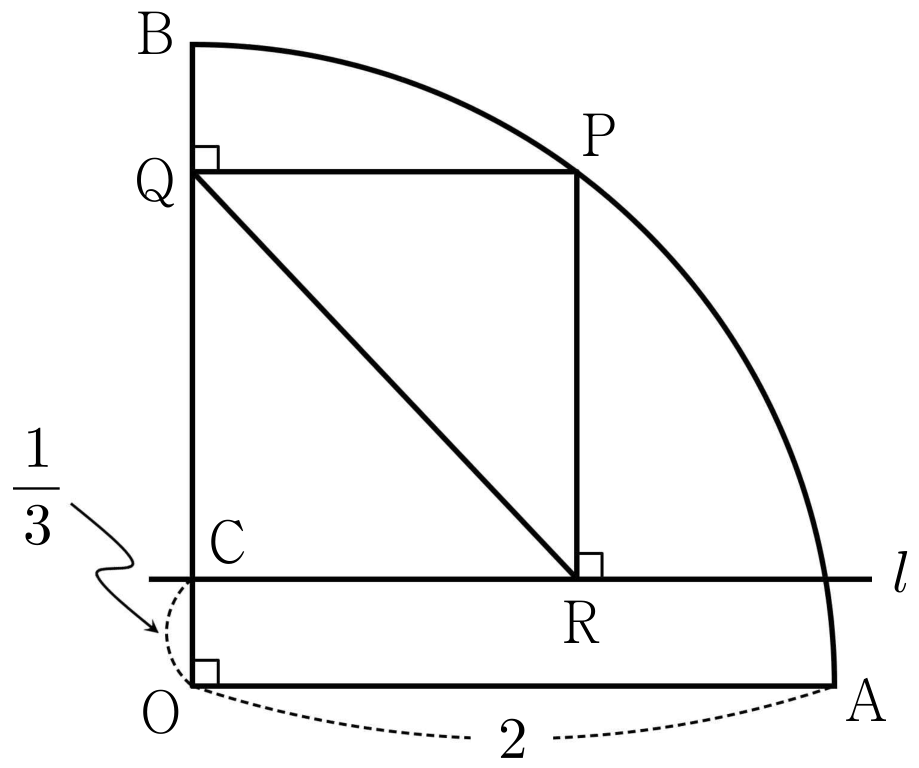
그림과 같이 반지름의 길이가 22이고 중심각의 크기가 9090 ^\circ인 부채꼴 OAB\mathrm{OAB}가 있다. 선분 OB\mathrm{OB} 위에 OC=13\displaystyle \mathrm{\overline{OC}} = \frac{1}{3}인 점 C\mathrm{C}를 잡고, 점 C\mathrm{C}를 지나고 선분 OA\mathrm{OA}와 평행한 직선을 ll이라 하자. 호 AB\mathrm{AB} 위를 움직이는 점 P\mathrm{P}에서 선분 OB\mathrm{OB}와 직선 ll에 내린 수선의 발을 각각 Q\mathrm{Q}, R\mathrm{R}라 할 때, 삼각형 PQR\mathrm{PQR}의 넓이의 최댓값은? [4점]

78\displaystyle \frac{\sqrt{7}}{8}76\displaystyle \frac{\sqrt{7}}{6}5724\displaystyle \frac{5 \sqrt{7}}{24}74\displaystyle \frac{\sqrt{7}}{4}7724\displaystyle \frac{7 \sqrt{7}}{24}

정답 보기

자료 내려받기

아직 올라온 파일이 없습니다.

해설

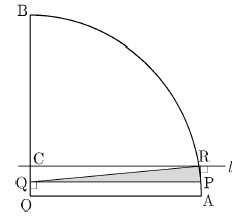
삼각형 PQR\mathrm{PQR}의 넓이는 12PQPR\displaystyle \frac{1}{2} \mathrm{\overline{PQ}} \cdot \overline{PR}이다. 직선 ll이 호 AB\mathrm{AB}와 만나는 점을 D\mathrm{D}라 하자. (ⅰ) 점 P\mathrm{P}가 점 A\mathrm{A}에서 출발하여 호 AD\mathrm{AD}를 따라 점 D\mathrm{D}까지 움직일 때, PQ\displaystyle \mathrm{\overline{PQ}}PR\displaystyle \mathrm{\overline{PR}}의 길이가 모두 감소한다.

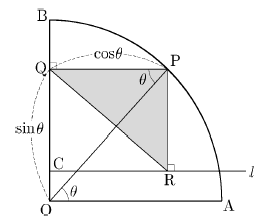
P\mathrm{P}가 점 A\mathrm{A}에 있을 때, 삼각형 PQR\mathrm{PQR}의 넓이는 13\displaystyle \frac{1}{3}이므로 점 P\mathrm{P}가 호 AD\mathrm{AD} 위에 있을 때, 삼각형 PQR\mathrm{PQR}의 넓이의 최댓값은 13\displaystyle \frac{1}{3}이다. (ⅱ) 점 P\mathrm{P}가 점 D\mathrm{D}에서 출발하여 호 AD\mathrm{AD}를 따라 점 B\mathrm{B}까지 움직일 때, OPA=θ\mathrm{\angle} OPA = \theta (\displaystyle \left( \begin{array}{l} \begin{matrix} \\ \end{matrix} \end{array} \right.αθπ2\displaystyle \alpha \leq \theta \leq \frac{\pi}{2}, DOA=α\mathrm{\angle} DOA = \alpha)\displaystyle \begin{matrix} \\ \end{matrix} )라 하면 OPQ=θ\mathrm{\angle} OPQ = \theta이므로 PQ\displaystyle \mathrm{\overline{PQ}}=2cosθ= 2 \cos \theta, OQ=2sinθ\displaystyle \mathrm{\overline{OQ}} = 2 \sin \theta이고 PR\displaystyle \mathrm{\overline{PR}}=CQ\displaystyle = \mathrm{\overline{CQ}}=OQOC\displaystyle = \mathrm{\overline{OQ}} - \overline{OC}=2sinθ13\displaystyle = 2 \sin \theta - \frac{1}{3}이다.

따라서 삼각형 PQR\mathrm{PQR}의 넓이를 f(θ)f ( \theta )라 하면 f(θ)f ( \theta )==12PQPR\displaystyle \frac{1}{2} \mathrm{\overline{PQ}} \cdot \overline{PR} =cosθ(2sinθ13)\displaystyle = \cos \theta \left( 2 \sin \theta - \frac{1}{3} \right) =sin2θ13cosθ\displaystyle = \sin 2 \theta - \frac{1}{3} \cos \theta f(θ)f' ( \theta )=2cos2θ+13sinθ\displaystyle = 2 \cos 2 \theta + \frac{1}{3} \sin \theta =24sin2θ+13sinθ\displaystyle = 2 - 4 \sin ^{2} \theta + \frac{1}{3} \sin \theta =13(3sinθ+2)(4sinθ3)\displaystyle = - \frac{1}{3} ( 3 \sin \theta + 2 ) ( 4 \sin \theta - 3 ) αθπ2\displaystyle \alpha \leq \theta \leq \frac{\pi}{2}에서 3sinθ+2>03 \sin \theta + 2 > 0이므로 f(θ)f ( \theta )sinθ=34\displaystyle \sin \theta = \frac{3}{4}일 때, 극대이자 최대이다. 이때, cosθ\cos \theta=1sin2θ\displaystyle = \sqrt{1 - \sin ^{2} \theta}=74\displaystyle = \frac{\sqrt{7}}{4}이므로 f(θ)f ( \theta )의 최댓값은 74(2×3413)\displaystyle \frac{\sqrt{7}}{4} \left( 2 \times \frac{3}{4} - \frac{1}{3} \right)=7724\displaystyle = \frac{7 \sqrt{7}}{24}이다. (ⅰ), (ⅱ)에서 f(θ)f ( \theta )의 최댓값은 7724\displaystyle \frac{7 \sqrt{7}}{24}이다.

태그

비슷한 문제 더 보기

← 전체 문제 목록으로