기하공간도형과 공간좌표수능 기출발전 문제 (3점 후반~4점 초반)

사면체와 내접원의 정사영

문제

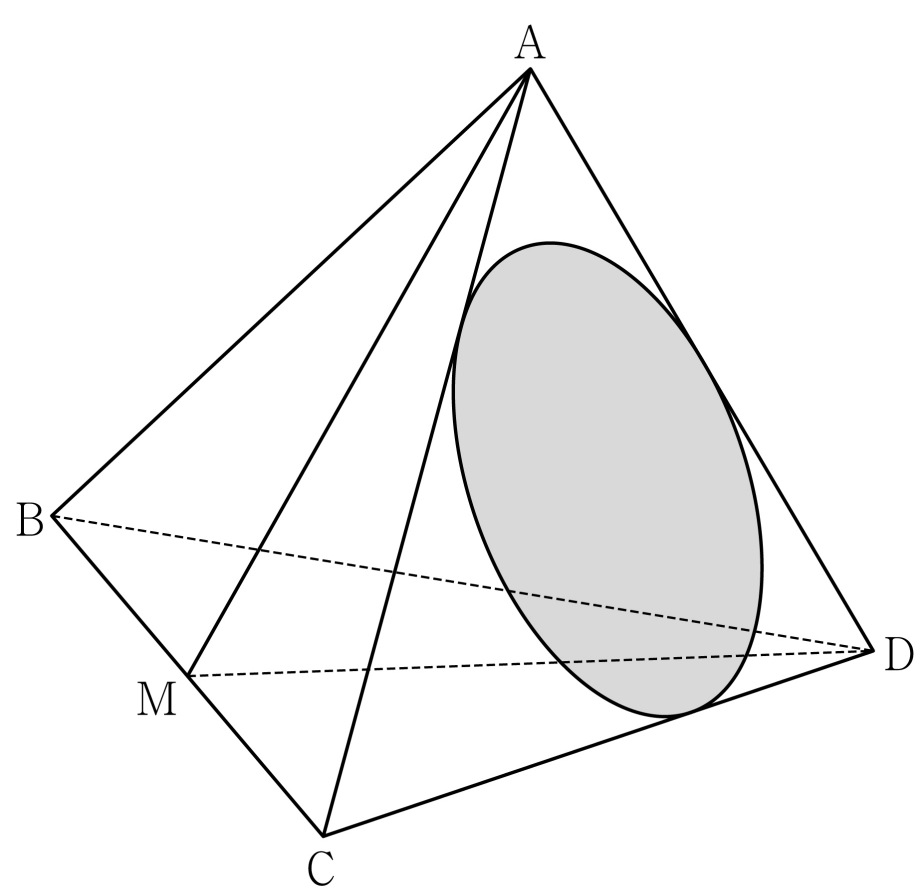
그림과 같이 AB=6\displaystyle \overline{{\mathrm{AB}}} = 6, BC=45\displaystyle \overline{{\mathrm{BC}}} = 4 \sqrt{5}인 사면체 ABCD\mathrm{ABCD}에 대하여 선분 BC\mathrm{BC}의 중점을 M\mathrm{M}이라 하자. 삼각형 AMD\mathrm{AMD}가 정삼각형이고 직선 BC\mathrm{BC}는 평면 AMD\mathrm{AMD}와 수직일 때, 삼각형 ACD\mathrm{ACD}에 내접하는 원의 평면 BCD\mathrm{BCD} 위로의 정사영의 넓이는? [3점]

104π\displaystyle \frac{\sqrt{10}}{4} \pi106π\displaystyle \frac{\sqrt{10}}{6} \pi108π\displaystyle \frac{\sqrt{10}}{8} \pi1010π\displaystyle \frac{\sqrt{10}}{10} \pi1012π\displaystyle \frac{\sqrt{10}}{12} \pi

정답 보기

자료 내려받기

아직 올라온 파일이 없습니다.

해설

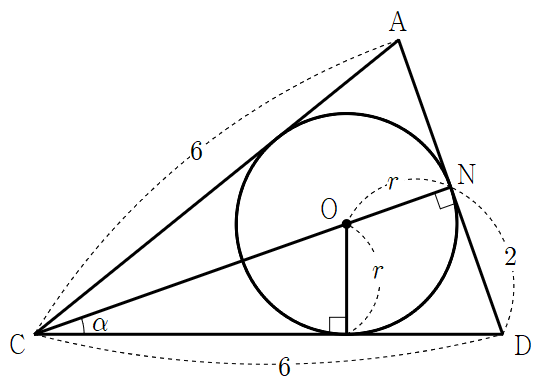
ABMACM\mathrm{\triangle} ABM \equiv \triangle ACM (SAS\mathrm{SAS}합동)이므로 AB=AC=6\displaystyle \mathrm{\overline{AB}} = \overline{AC} = 6 마찬가지로 AM=DM\displaystyle \mathrm{\overline{AM}} = \overline{DM}, DMBC\displaystyle \mathrm{\overline{DM}} \perp \overline{BC}이므로 ABCDBC\mathrm{\triangle} ABC \equiv \triangle DBC DB=DC=6\displaystyle \mathrm{\overline{DB}} = \overline{DC} = 6이고, AD=4\displaystyle \mathrm{\overline{AD}} = 4이므로 삼각형 ACD\mathrm{ACD}는 이등변삼각형이다. 삼각형 ACD\mathrm{ACD}에서 선분 AD\mathrm{AD}의 중점을 N\mathrm{N}, 삼각형 ACD\mathrm{ACD}의 내접원의 중심을 O\mathrm{O}, 내접원의 반지름의 길이를 rr, DCN=α\mathrm{\angle} DCN \mathit{=} \alpha라 하면

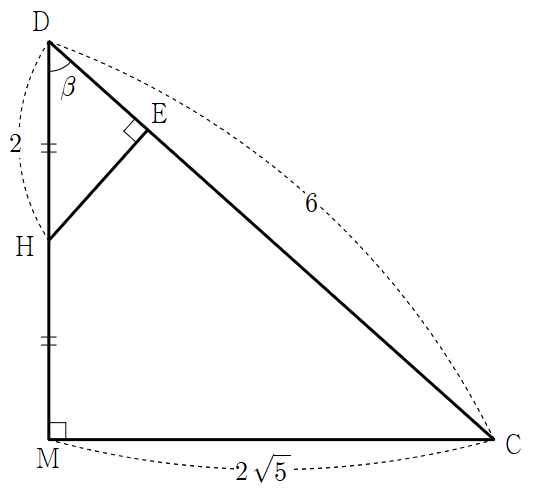
DN=2\displaystyle \mathrm{\overline{DN}} = 2이므로 CN\displaystyle \mathrm{\overline{CN}}=6222\displaystyle = \sqrt{6 ^{2} - 2 ^{2}}=42\displaystyle = 4 \sqrt{2} sinα\sin \alpha=DNCD\displaystyle = \frac{\mathrm{\overline{DN}}}{\overline{CD}}=rOC\displaystyle = \frac{\mathit{r}}{\mathrm{\overline{OC}}}, 13=r42r\displaystyle \frac{1}{3} = \frac{r}{4 \sqrt{2} - r} 42r=3r\displaystyle 4 \sqrt{2} - r = 3 r \therefore r=2\displaystyle r = \sqrt{2} 삼각형 ACD\mathrm{ACD}의 내접원의 넓이를 S1S _{1}이라 하면 S1S _{1}=2π= 2 \pi \cdots\cdots ㉠ 점 A\mathrm{A}에서 선분 DM\mathrm{DM}에 내린 수선의 발을 H\mathrm{H}라 하면 삼각형 AMD\mathrm{AMD}는 정삼각형이므로 점 H\mathrm{H}는 선분 DM\mathrm{DM}의 중점이다. \therefore AH=23\displaystyle \mathrm{\overline{AH}} = 2 \sqrt{3}, DH=2\displaystyle \mathrm{\overline{DH}} = 2H\mathrm{H}에서 선분 CD\mathrm{CD}에 내린 수선의 발을 E\mathrm{E}라 하고 삼각형 DMC\mathrm{DMC}에서 CDM=β\mathrm{\angle} CDM = \beta라 하면

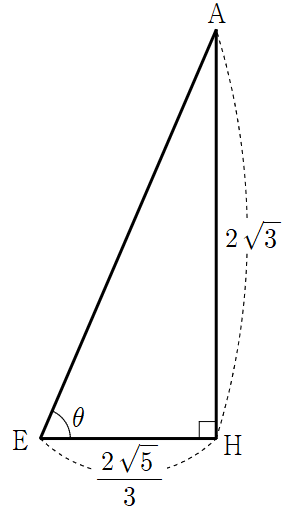
sinβ\sin \beta=CMCD=HEDH\displaystyle = \frac{\mathrm{\overline{CM}}}{\overline{CD}} = \frac{\overline{HE}}{DH}, 256=EH2\displaystyle \frac{2 \sqrt{5}}{6} = \frac{\mathrm{\overline{EH}}}{2} \therefore EH=253\displaystyle \mathrm{\overline{EH}} = \frac{2 \sqrt{5}}{3} 두 평면 ACD\mathrm{ACD}BCD\mathrm{BCD}가 이루는 각을 θ\theta라 하면 AEH=θ\mathrm{\angle} AEH = \theta이므로 직각삼각형 AHE\begin{aligned} \mathrm{AHE} \\ \end{aligned}에서

AE\displaystyle \mathrm{\overline{AE}}=AH2+EH2\displaystyle = \mathrm{\sqrt{{\overline{AH}} ^{2} + {\overline{EH}} ^{2}}}=1289\displaystyle = \sqrt{\frac{128}{9}}=823\displaystyle = \frac{8 \sqrt{2}}{3} \therefore cosθ\cos \theta=EHAE\displaystyle = \frac{\mathrm{\overline{EH}}}{\overline{AE}}=253823\displaystyle = \frac{\frac{2 \sqrt{5}}{3}}{\frac{8 \sqrt{2}}{3}}=108\displaystyle = \frac{\sqrt{10}}{8} 이때 삼각형 ACD\mathrm{ACD}의 내접원의 평면 BCD\mathrm{BCD} 위로의 정사영의 넓이를 S2S _{2}라 하면 S2S _{2}=S1×cosθ= S _{1} \times \cos \theta=2π×108\displaystyle = 2 \pi \times \frac{\sqrt{10}}{8}=104π\displaystyle = \frac{\sqrt{10}}{4} \pi

태그

비슷한 문제 더 보기

← 전체 문제 목록으로