기하공간도형과 공간좌표수능 기출심화 문제 (4점 중반 이후, 킬러 직전)

사면체 이면각

문제

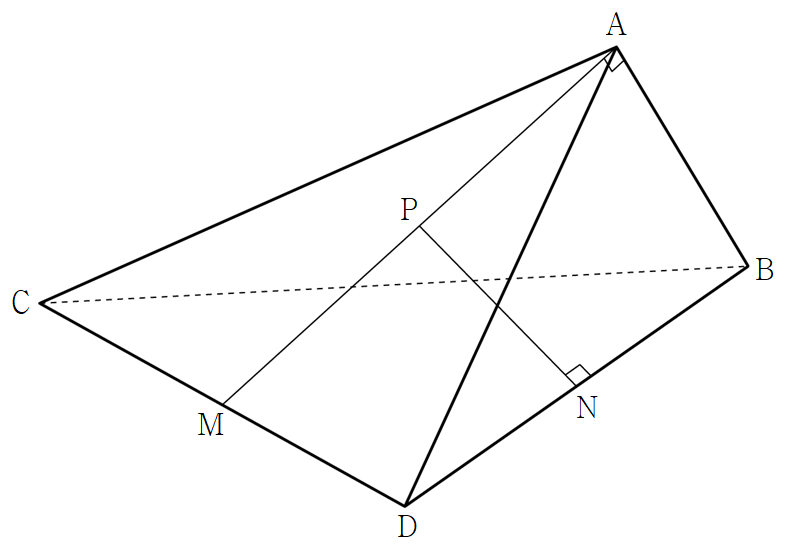
그림과 같이 AB\displaystyle {\overline{\mathrm{AB}}}=4= 4, CD\displaystyle {\overline{\mathrm{CD}}}=8= 8, BC\displaystyle {\overline{\mathrm{BC}}}=BD\displaystyle = {\overline{\mathrm{BD}}}=45\displaystyle = 4 \sqrt{5} 인 사면체 ABCD\mathrm{ABCD}에 대하여 직선 AB\mathrm{AB}와 평면 ACD\mathrm{ACD}는 서로 수직이다. 두 선분 CD\mathrm{CD}, DB\mathrm{DB}의 중점을 각각 M,N\mathrm{M} , N이라 할 때, 선분 AM\mathrm{AM} 위의 점 P\mathrm{P}에 대하여 선분 DB\mathrm{DB}와 선분 PN\mathrm{PN}은 서로 수직이다. 두 평면 PDB\mathrm{PDB}CDB\mathrm{CDB}가 이루는 예각의 크기를 θ\theta라 할 때, 40cos2θ40 \cos ^{2} \theta의 값을 구하시오. [4점]

정답 보기
25

자료 내려받기

아직 올라온 파일이 없습니다.

해설

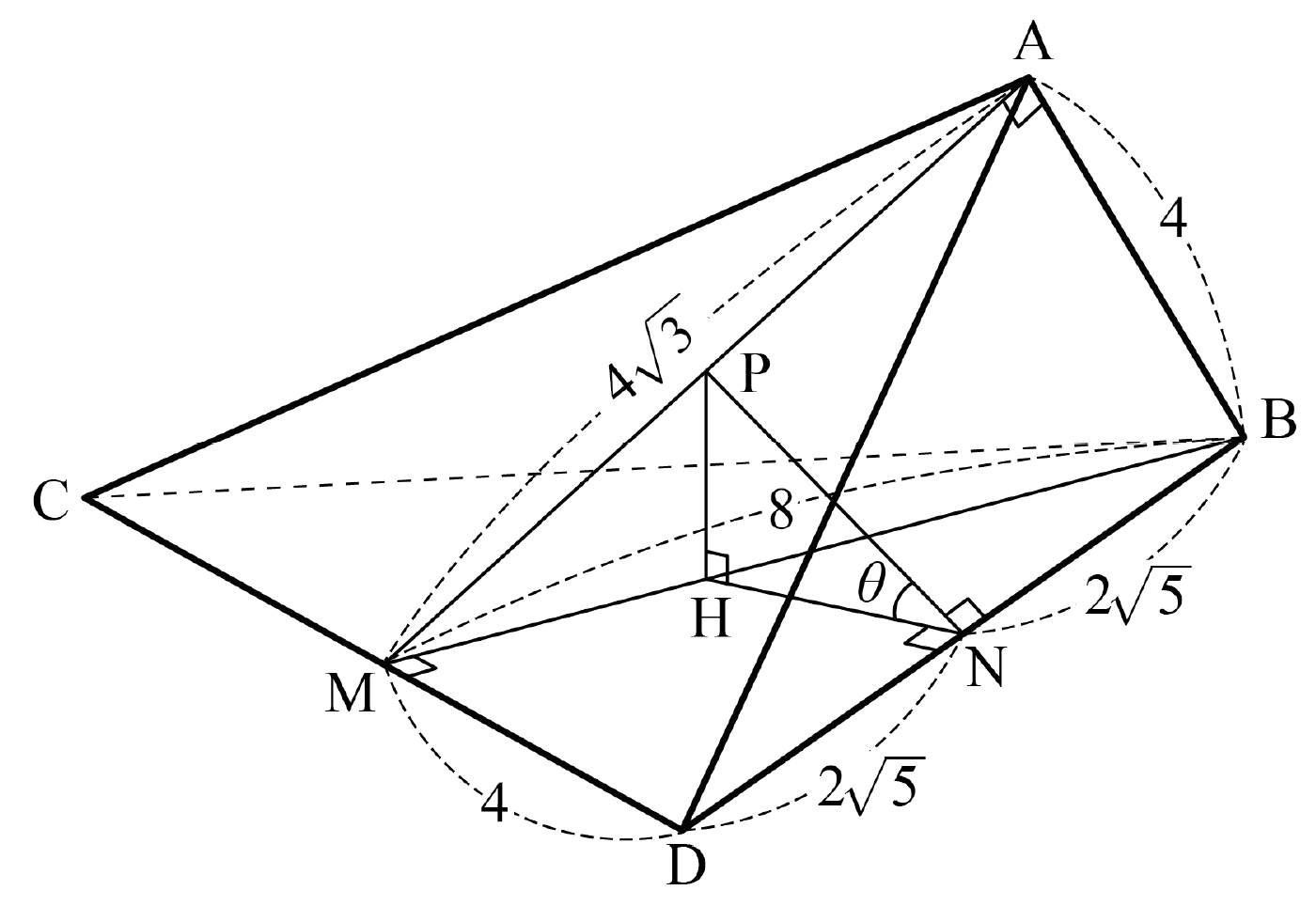
[출제의도] 공간도형을 활용하여 문제해결하기 BMD\angle \mathrm{BMD}=π2\displaystyle = \frac{\pi}{2}이므로 BM\displaystyle {\overline{\mathrm{BM}}}=8= 8 BAM\angle \mathrm{BAM}=π2\displaystyle = \frac{\pi}{2}이므로 AM\displaystyle {\overline{\mathrm{AM}}}=43\displaystyle = 4 \sqrt{3}

P\mathrm{P}에서 직선 BM\mathrm{BM}에 내린 수선의 발을 H\mathrm{H}라 하면 PMBM\displaystyle {\overline{\mathrm{PM}}} \perp {\overline{\mathrm{BM}}} \cdots \cdots ㉠ 직선 AB\mathrm{AB}와 평면 ACD\mathrm{ACD}가 서로 수직이므로 ABCD\displaystyle {\overline{\mathrm{AB}}} \perp {\overline{\mathrm{CD}}} 직선 CD\mathrm{CD}는 두 직선 AB,BM\mathrm{AB} , BM과 서로 수직이므로 CD\displaystyle {\overline{\mathrm{CD}}} \perp(평면 AMB\mathrm{AMB}) 직선 PH\mathrm{PH}는 평면 AMB\mathrm{AMB}에 포함되므로 PHCD\displaystyle {\overline{\mathrm{PH}}} \perp {\overline{\mathrm{CD}}} \cdots \cdots ㉡ ㉠, ㉡에 의하여 PH\displaystyle {\overline{\mathrm{PH}}} \perp(평면 CDB\mathrm{CDB}) PH\displaystyle {\overline{\mathrm{PH}}} \perp(평면 CDB\mathrm{CDB})이고 PNBD\displaystyle {\overline{\mathrm{PN}}} \perp {\overline{\mathrm{BD}}}이므로 삼수선의 정리에 의하여 HNBD\displaystyle {\overline{\mathrm{HN}}} \perp {\overline{\mathrm{BD}}} 두 삼각형 DBM\mathrm{DBM}HBN\mathrm{HBN}은 서로 닮은 도형이므로 BM:MD\displaystyle {\overline{\mathrm{BM}}} : {\overline{\mathrm{MD}}}=BN:NH\displaystyle = {\overline{\mathrm{BN}}} : {\overline{\mathrm{NH}}}에서 NH\displaystyle {\overline{\mathrm{NH}}}=MD×BNBM\displaystyle = \frac{{\overline{\mathrm{MD}}} \times {\overline{\mathrm{BN}}}}{{\overline{\mathrm{BM}}}}=5\displaystyle = \sqrt{5} BNH\angle \mathrm{BNH}=π2\displaystyle = \frac{\pi}{2}이므로 BH2\displaystyle {\overline{\mathrm{BH}}} ^{2}=BN2+NH2\displaystyle = {\overline{\mathrm{BN}}} ^{2} + {\overline{\mathrm{NH}}} ^{2}=25= 25 BH\displaystyle {\overline{\mathrm{BH}}}=5= 5, MH\displaystyle {\overline{\mathrm{MH}}}=3= 3 tan(AMB)\tan \left( \angle \mathrm{AMB} \right)=33\displaystyle = \frac{\sqrt{3}}{3}이므로 PH\displaystyle {\overline{\mathrm{PH}}}=3\displaystyle = \sqrt{3} PN2\displaystyle {\overline{\mathrm{PN}}} ^{2}=PH2+HN2\displaystyle = {\overline{\mathrm{PH}}} ^{2} + {\overline{\mathrm{HN}}} ^{2}=8= 8 PN\displaystyle {\overline{\mathrm{PN}}}=22\displaystyle = 2 \sqrt{2} 두 평면 PDB\mathrm{PDB}, CDB\mathrm{CDB}의 교선은 직선 DB\mathrm{DB}이고 평면 PDB\mathrm{PDB} 위의 점 P\mathrm{P}의 평면 CDB\mathrm{CDB} 위로의 정사영이 H\mathrm{H}이므로 cosθ\cos \theta=HNPN\displaystyle = \frac{{\overline{\mathrm{HN}}}}{{\overline{\mathrm{PN}}}}=522\displaystyle = \frac{\sqrt{5}}{2 \sqrt{2}}=104\displaystyle = \frac{\sqrt{10}}{4} 따라서 40cos2θ40 \cos ^{2} \theta=25= 25

태그

비슷한 문제 더 보기

← 전체 문제 목록으로