중학중학 미분류수능 기출심화 문제 (4점 중반 이후, 킬러 직전)

내심과 수선의 발 거리

문제

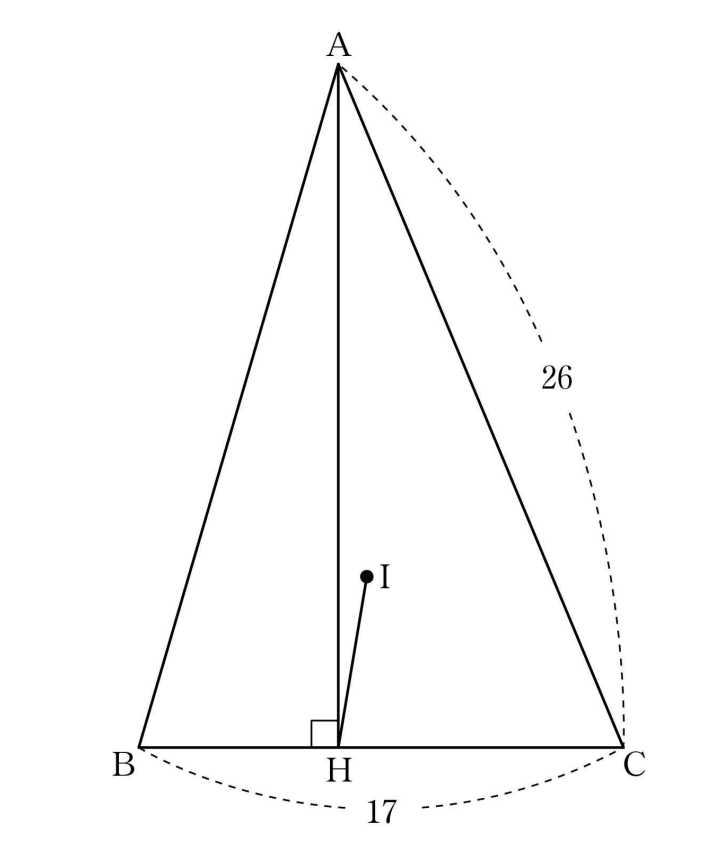
그림과 같이 AC=26\displaystyle {\overline{\mathrm{AC}}} = 26, BC=17\displaystyle {\overline{\mathrm{BC}}} = 17인 예각삼각형 ABC{\mathrm{ABC}}가 있다. 삼각형 ABC{\mathrm{ABC}}의 내심을 I{\mathrm{I}}, 점 A{\mathrm{A}}에서 변 BC{\mathrm{BC}}에 내린 수선의 발을 H{\mathrm{H}}라 하자. 삼각형 ABC{\mathrm{ABC}}의 넓이가 204204일 때, IH2\displaystyle {\overline{\mathrm{IH}}} ^{2}의 값을 구하시오. [4점]

정답 보기
37

자료 내려받기

아직 올라온 파일이 없습니다.

해설

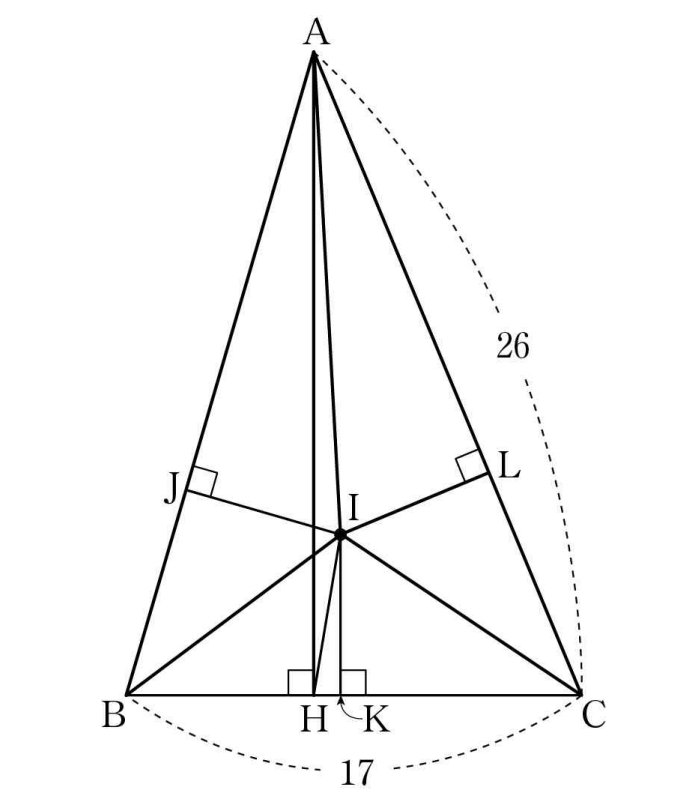
삼각형 ABC{\mathrm{ABC}}의 넓이가 204204이므로 ABC=12×BC×AH=12×17×AH=204\displaystyle \triangle {\mathrm{ABC}} \frac{= \mathit{1}}{2} \times {\overline{\mathrm{BC}}} \times {\overline{\mathrm{AH}}} = \frac{1}{2} \times 17 \times {\overline{\mathrm{AH}}} = 204 AH=24\displaystyle {\overline{\mathrm{AH}}} = 24 직각삼각형 AHC{\mathrm{AHC}}에서 피타고라스 정리에 의하여 AC2=AH2+HC2\displaystyle {\overline{\mathrm{AC}}} ^{2} \mathit{=} {\overline{\mathrm{AH}}} ^{2} \mathit{+} {\overline{\mathrm{HC}}} ^{2} HC2\displaystyle {\overline{\mathrm{HC}}} ^{2}=AC2AH2\displaystyle = {\overline{\mathrm{AC}}} ^{2} \mathit{-} {\overline{\mathrm{AH}}} ^{2}=262242=100= 26 ^{2} - 24 ^{2} = 100 HC=10\displaystyle {\overline{\mathrm{HC}}} = 10 BH=BCHC=1710=7\displaystyle {\overline{\mathrm{BH}}} = {\overline{\mathrm{BC}}} - {\overline{\mathrm{HC}}} = 17 - 10 = 7 직각삼각형 ABH{\mathrm{ABH}}에서 피타고라스 정리에 의하여 AB2\displaystyle {\overline{\mathrm{AB}}} ^{2}=BH2+AH2\displaystyle = {\overline{\mathrm{BH}}} ^{2} \mathit{+} {\overline{\mathrm{AH}}} ^{2}=72+242=625= 7 ^{2} + 24 ^{2} = 625 AB=25\displaystyle {\overline{\mathrm{AB}}} = 25I{\mathrm{I}}에서 세 변 AB{\mathrm{AB}}, BC{\mathrm{BC}}, CA{\mathrm{CA}}에 내린 수선의 발을 각각 J{\mathrm{J}}, K{\mathrm{K}}, L{\mathrm{L}}이라 하자. 삼각형 ABC{\mathrm{ABC}}의 내접원의 반지름의 길이를 rr라 하면 삼각형의 내심의 성질에 의하여 IJ=IK=IL=r\displaystyle {\overline{\mathrm{IJ}}} = {\overline{\mathrm{IK}}} = {\overline{\mathrm{IL}}} = r ABC\triangle {\mathrm{ABC}}=IAB+IBC+ICA= \triangle {\mathrm{IAB}} \mathit{+} \triangle {\mathrm{IBC}} \mathit{+} \triangle {\mathrm{ICA}} =12×AB×r+12×BC×r+12×CA×r\displaystyle = \frac{1}{2} \times {\overline{\mathrm{AB}}} \times r + \frac{1}{2} \times {\overline{\mathrm{BC}}} \times r + \frac{1}{2} \times {\overline{\mathrm{CA}}} \times r =12×(25+17+26)×r\displaystyle = \frac{1}{2} \times \left( 25 + 17 + 26 \right) \times r=34r= 34 r 34r=20434 r = 204에서 r=6r = 6 두 직각삼각형 IKC{\mathrm{IKC}}, ILC{\mathrm{ILC}}에서 IKC=ILC=90\angle {\mathrm{IKC}} = \mathit{\angle} {\mathrm{ILC}} = \mathit{90} ^\circ, IK=IL\displaystyle {\overline{\mathrm{IK}}} = {\overline{\mathrm{IL}}}, IC\displaystyle {\overline{\mathrm{IC}}}는 공통이므로 두 직각삼각형 IKC{\mathrm{IKC}}, ILC{\mathrm{ILC}}는 서로 합동이다. 그러므로 CK=CL\displaystyle {\overline{\mathrm{CK}}} = {\overline{\mathrm{CL}}} 같은 방법으로 두 직각삼각형 ICB{\mathrm{\text{열} ICB}}, (5+1){\mathrm{\left( 5 + 1 \right)}}가 서로 합동이고 AL=AJ\displaystyle {\overline{\mathrm{AL}}} = {\overline{\mathrm{AJ}}}, 두 직각삼각형 IJB{\mathrm{IJB}}, IKB{\mathrm{IKB}}가 서로 합동이고 BJ=BK\displaystyle {\overline{\mathrm{BJ}}} = {\overline{\mathrm{BK}}} HK=x\displaystyle {\overline{\mathrm{HK}}} = x라 하면 CK=CL=10x\displaystyle {\overline{\mathrm{CK}}} = {\overline{\mathrm{CL}}} = 10 - x AL=AJ=26(10x)=16+x\displaystyle {\overline{\mathrm{AL}}} = {\overline{\mathrm{AJ}}} = 26 - \left( 10 - x \right) = 16 + x BJ=BK=25(16+x)=9x\displaystyle {\overline{\mathrm{BJ}}} = {\overline{\mathrm{BK}}} = 25 - \left( 16 + x \right) = 9 - x BC\displaystyle {\overline{\mathrm{BC}}}=BK+KC\displaystyle = {\overline{\mathrm{BK}}} + {\overline{\mathrm{KC}}}=(9x)+(10x)= \left( 9 - x \right) + \left( 10 - x \right)=192x=17= 19 - 2 x = 17 2x=22 x = 2, x=1x = 1 직각삼각형 IHK{\mathrm{IHK}}에서 HK=1\displaystyle {\overline{\mathrm{HK}}} = 1, IK=6\displaystyle {\overline{\mathrm{IK}}} = 6 피타고라스 정리에 의하여 IH2\displaystyle {\overline{\mathrm{IH}}} ^{2}=HK2+IK2=12+62\displaystyle = {\overline{\mathrm{HK}}} ^{2} \mathit{+} {\overline{\mathrm{IK}}} ^{2} \mathit{=} 1 ^{2} + 6 ^{2}=37= 37

태그

비슷한 문제 더 보기

← 전체 문제 목록으로