중학중학 미분류수능 기출발전 문제 (3점 후반~4점 초반)

직사각형 넓이와 이차방정식

문제

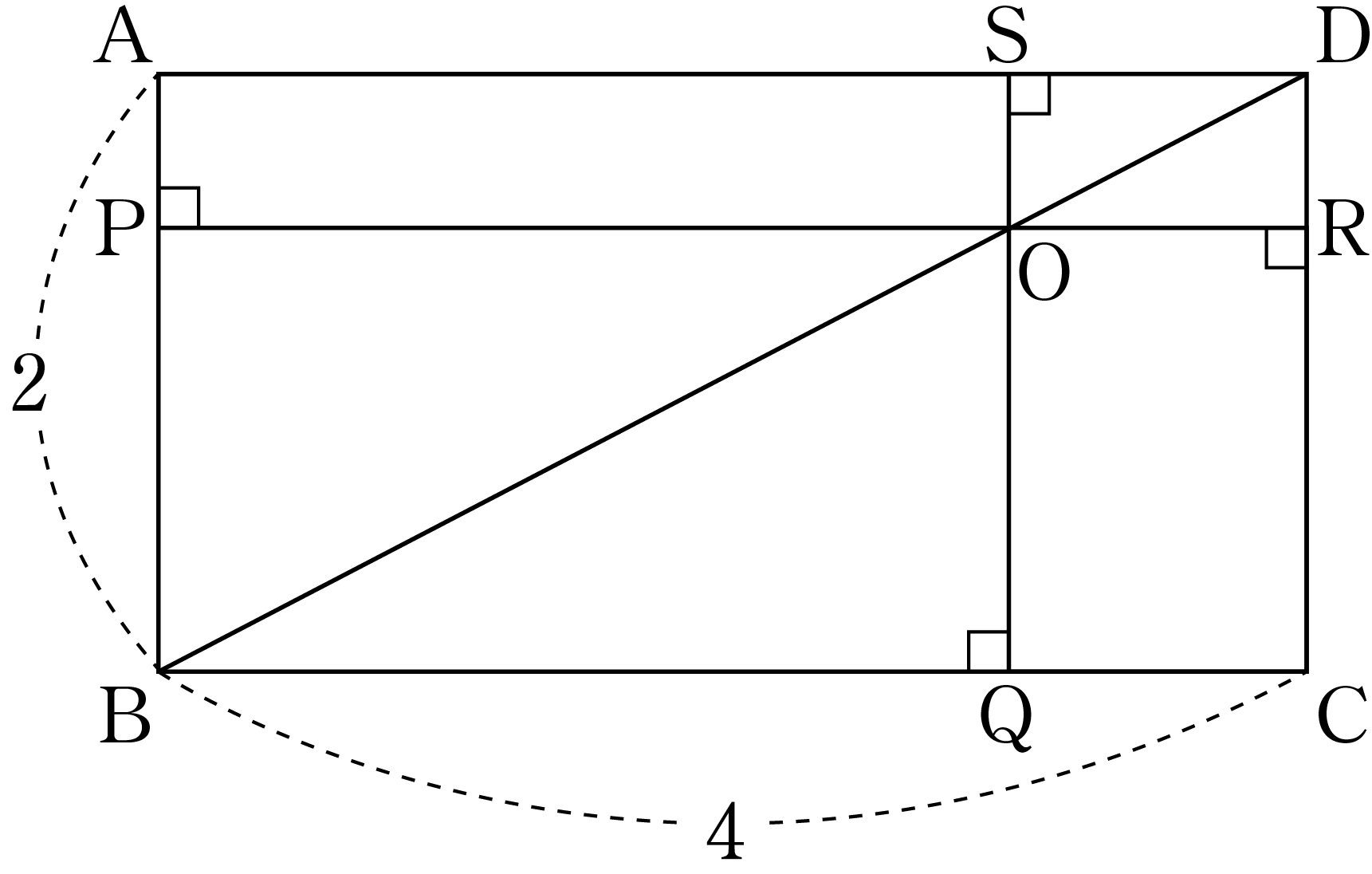
그림과 같이 AB=2\displaystyle \mathrm{\overline{AB}} = 2, BC=4\displaystyle \mathrm{\overline{BC}} = 4인 직사각형 ABCD\mathrm{ABCD}가 있다. 대각선 BD\mathrm{BD} 위에 한 점 O\mathrm{O}를 잡고, 점 O\mathrm{O}에서 네 변 AB\mathrm{AB}, BC\mathrm{BC}, CD\mathrm{CD}, DA\mathrm{DA}에 내린 수선의 발을 각각 P\mathrm{P}, Q\mathrm{Q}, R\mathrm{R}, S\mathrm{S}라 하자. 사각형 APOS\mathrm{APOS}와 사각형 OQCR\mathrm{OQCR}의 넓이의 합이 33이고 AP<PB\displaystyle \mathrm{\overline{AP}} \mathit{<} {\overline{\mathrm{PB}}}일 때, 선분 AP\mathrm{AP}의 길이는? [4점]

38\displaystyle \frac{3}{8}716\displaystyle \frac{7}{16}12\displaystyle \frac{1}{2}916\displaystyle \frac{9}{16}58\displaystyle \frac{5}{8}

정답 보기

자료 내려받기

아직 올라온 파일이 없습니다.

해설

[출제의도] 주어진 상황에 맞는 이차방정식을 세워 선분의 길이를 구한다.
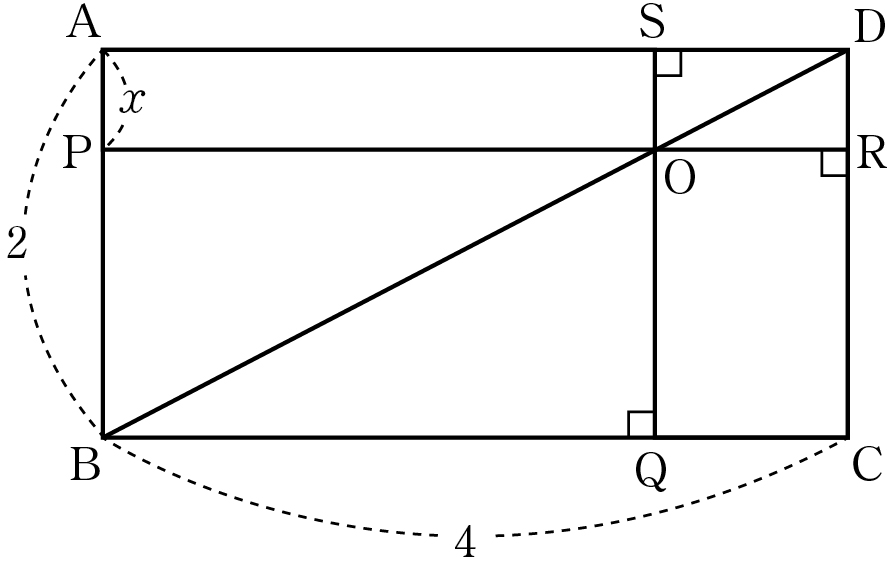
두 삼각형 ABD\mathrm{ABD}와 삼각형 SOD\mathrm{SOD}에서 DAB=DSO=90\mathrm{\angle} DAB = \mathrm{\angle} DSO = 90 \mathit{^\circ}, ADB\mathrm{\angle} ADB는 공통이므로 두 삼각형 ABD\mathrm{ABD}와 삼각형 SOD\mathrm{SOD}는 서로 닮음이다. 따라서 AB:AD\displaystyle {\overline{\mathrm{AB}}} \mathit{:} {\overline{\mathrm{AD}}}=SO:SD\displaystyle = {\overline{\mathrm{SO}}} \mathit{:} {\overline{\mathrm{SD}}} AB=2\displaystyle \mathrm{\overline{AB}} = 2, BC=AD=4\displaystyle \mathrm{\overline{BC}} = \mathrm{\overline{AD}} = 4이므로 SO:SD=1:2\displaystyle {\overline{\mathrm{SO}}} \mathit{:} {\overline{\mathrm{SD}}} = 1 : 2 AP=x\displaystyle {\overline{\mathrm{AP}}} = x라 하면 SO\displaystyle {\overline{\mathrm{SO}}}=AP\displaystyle = {\overline{\mathrm{AP}}}=x= x SD\displaystyle {\overline{\mathrm{SD}}}=2SO\displaystyle = 2 \mathrm{\overline{SO}}=2x= 2 x 따라서 사각형 APOS\mathrm{APOS}의 넓이는 AP×AS\displaystyle \mathrm{\overline{AP}} \times \mathrm{\overline{AS}}=AP×(ADSD)\displaystyle = \mathrm{\overline{AP}} \times \left( \mathrm{\overline{AD}} - \overline{SD} \right)=x×(42x)= x \times \left( 4 - 2 x \right)=4x2x2= 4 x - 2 x ^{2} 사각형 OQCR\mathrm{OQCR}의 넓이는 OQ×OR\displaystyle \mathrm{\overline{OQ}} \times \mathrm{\overline{OR}}=(SQSO)×OR\displaystyle = \left( \mathrm{\overline{SQ}} - {\overline{SO}} \right) \times \mathrm{\overline{OR}}=(ABAP)×SD\displaystyle = \left( \mathrm{\overline{AB}} - {\overline{AP}} \right) \times \mathrm{\overline{SD}} =(2x)×2x= \left( 2 - x \right) \times 2 x=4x2x2= 4 x - 2 x ^{2} 조건에서 사각형 APOS\mathrm{APOS}의 넓이와 사각형 OQCR\mathrm{OQCR}의 넓이의 합이 33이므로 4x2x2+4x2x2=34 x - 2 x ^{2} + 4 x - 2 x ^{2} = 3 4x28x+3=04 x ^{2} - 8 x + 3 = 0 (2x3)(2x1)=0\left( 2 x - 3 \right) \left( 2 x - 1 \right) = 0 x=32\displaystyle x = \frac{3}{2} 또는 x=12\displaystyle x = \frac{1}{2} 조건에서 AP<PB\displaystyle \mathrm{\overline{AP}} \mathit{<} {\overline{\mathrm{PB}}}이므로 x<2xx < 2 - x, x<1x < 1 따라서 x=12\displaystyle x = \frac{1}{2} 그러므로 AP\displaystyle \mathrm{\overline{AP}}=12\displaystyle = \frac{1}{2} [다른 풀이] 사각형 APOS\mathrm{APOS}의 넓이와 사각형 OQCR\mathrm{OQCR}의 넓이의 합은 직사각형 ABCD\mathrm{ABCD}의 넓이에서 직사각형 PBQO\mathrm{PBQO}의 넓이와 직사각형 SORD\mathrm{SORD}의 넓이를 뺀 것과 같다. AP=x\displaystyle {\overline{\mathrm{AP}}} = x라 할 때, 직사각형 PBQO\mathrm{PBQO}의 넓이는 다음과 같이 xx에 관한 식으로 나타낼 수 있다. PB×PO\displaystyle \mathrm{\overline{PB}} \times \mathrm{\overline{PO}}=(ABAP)×(ADSD)\displaystyle = \left( \mathrm{\overline{AB}} - {\overline{AP}} \right) \times \left( \mathrm{\overline{AD}} - {\overline{SD}} \right)=(2x)(42x)= \left( 2 - x \right) \left( 4 - 2 x \right) =2x28x+8= 2 x ^{2} - 8 x + 8 마찬가지로 직사각형 SORD\mathrm{SORD}의 넓이도 xx에 관한 식으로 나타낼 수 있다. SO×SD\displaystyle \mathrm{\overline{SO}} \times \mathrm{\overline{SD}}=AP×SD\displaystyle = \mathrm{\overline{AP}} \times \mathrm{\overline{SD}}=x×2x= x \times 2 x=2x2= 2 x ^{2} 조건에서 사각형 APOS\mathrm{APOS}의 넓이와 사각형 OQCR\mathrm{OQCR}의 넓이의 합이 33이므로 8(2x28x+8)2x2=38 - \left( 2 x ^{2} - 8 x + 8 \right) - 2 x ^{2} = 3 4x28x+3=04 x ^{2} - 8 x + 3 = 0 (2x3)(2x1)=0\left( 2 x - 3 \right) \left( 2 x - 1 \right) = 0 x=32\displaystyle x = \frac{3}{2} 또는 x=12\displaystyle x = \frac{1}{2} x<1x < 1이므로 x=12\displaystyle x = \frac{1}{2}

태그

비슷한 문제 더 보기

← 전체 문제 목록으로