중학중학 미분류수능 기출심화 문제 (4점 중반 이후, 킬러 직전)

두 이차함수와 사각형

문제

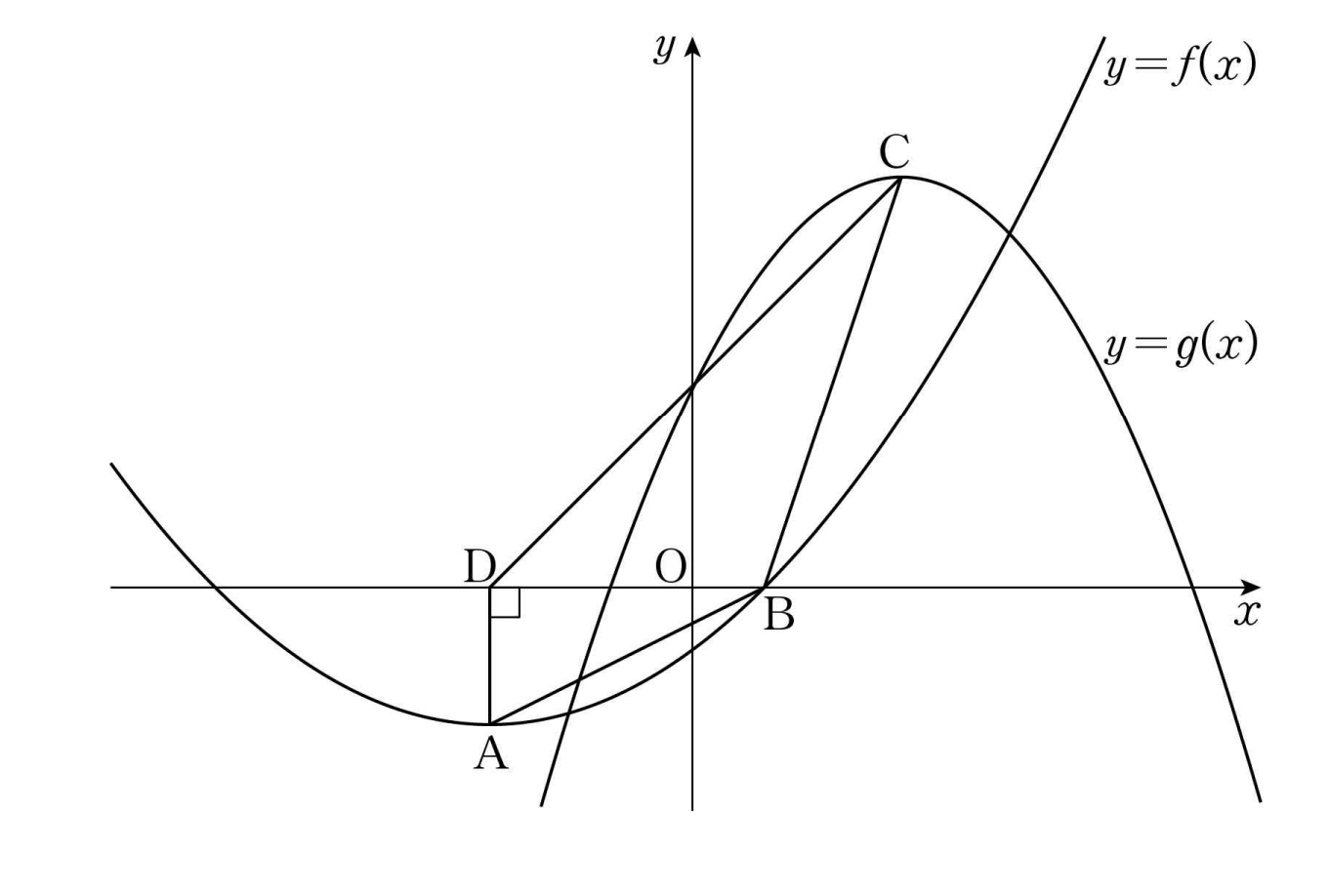
그림과 같이 양수 aa에 대하여 꼭짓점이 A(3,a)\mathrm{A} \mathit{\left( - 3 , - a \right)}이고 점 B(1,0)\mathrm{B} \mathit{\left( 1 , 0 \right)}을 지나는 이차함수 y=f(x)y = f \left( x \right)의 그래프와 꼭짓점이 C(3,3a)\mathrm{C} \mathit{\left( 3 , 3 a \right)}인 이차함수 y=g(x)y = g \left( x \right)의 그래프가 있다. 점 A\mathrm{A}에서 xx축에 내린 수선의 발을 D\mathrm{D}라 할 때, 사각형 ABCD\mathrm{ABCD}의 넓이는 16\mathrm{16}이다. 이차함수 y=g(x)y = g \left( x \right)의 그래프가 yy축과 만나는 점이 선분 CD\mathrm{CD} 위에 있을 때, f(1)×g(3)f \left( - 1 \right) \times g \left( - 3 \right)의 값을 구하시오. [4점]

정답 보기
9

자료 내려받기

아직 올라온 파일이 없습니다.

해설

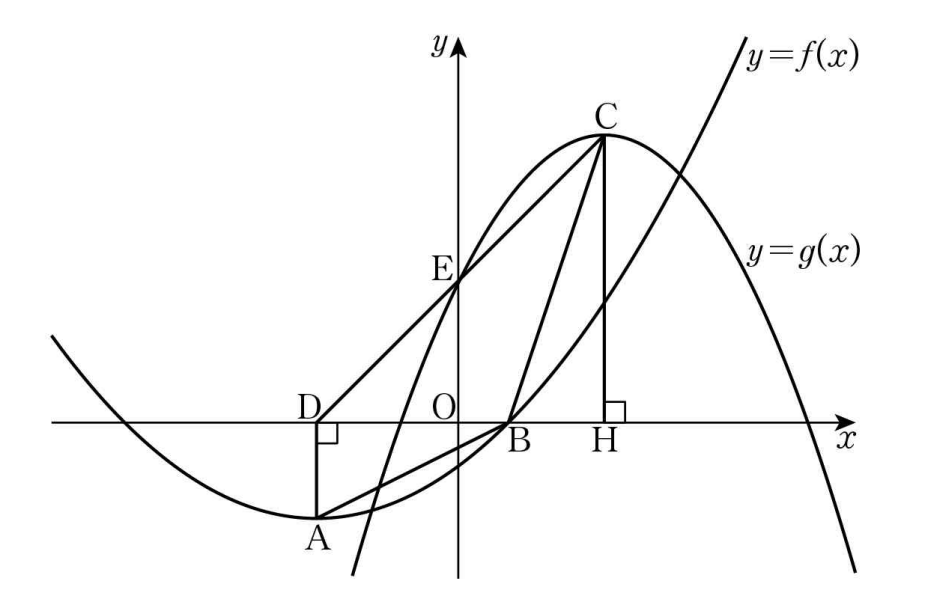
D{\mathrm{D}}는 점 A{\mathrm{A}}에서 xx축에 내린 수선의 발이므로 점 D{\mathrm{D}}의 좌표는 (3,0)\left( - 3 , 0 \right) DB=DO+OB=3+1=4\displaystyle {\overline{\mathrm{DB}}} = {\overline{\mathrm{DO}}} + {\overline{\mathrm{OB}}} = 3 + 1 = 4 삼각형 DAB\mathrm{DAB}에서 밑변을 선분 DB\mathrm{DB}라 하면 높이가 DA\displaystyle {\overline{\mathrm{DA}}}이므로 DAB\triangle \mathrm{DAB}=12×DB×DA=12×4×a\displaystyle = \frac{1}{2} \times {\overline{\mathrm{DB}}} \times {\overline{\mathrm{DA}}} = \frac{1}{2} \times 4 \times a=2a= 2 a 삼각형 CDB\mathrm{CDB}에서 밑변을 선분 DB\mathrm{DB}라 하면 높이가 3a3 a이므로 CDB\triangle \mathrm{CDB}=12×DB×3a\displaystyle = \frac{1}{2} \times {\overline{\mathrm{DB}}} \times 3 a=12×4×3a\displaystyle = \frac{1}{2} \times 4 \times 3 a=6a= 6 a ABCD\square \mathrm{ABCD}=DAB+CDB= \triangle \mathrm{DAB} \mathit{+} \triangle \mathrm{CDB}=2a+6a= 2 a + 6 a=8a= 8 a ABCD=16\square \mathrm{ABCD} \mathit{=} 16이므로 a=2a = 2A{\mathrm{A}}의 좌표는 (3,2)\left( - 3 , - 2 \right)이고 점 C\mathrm{C}의 좌표는 (3,6)\left( 3 , 6 \right) 이차함수 y=f(x)y = f \left( x \right)의 그래프의 꼭짓점이 점 A{\mathrm{A}}이므로 f(x)=p(x+3)22(pf \left( x \right) = p \left( x + 3 \right) ^{2} - 2 \left( p \right.는 상수)) 이차함수 y=f(x)y = f \left( x \right)의 그래프가 점 B(1,0)\mathrm{B} \mathit{\left( 1 , 0 \right)}을 지나므로 f(1)=p(1+3)22=16p2=0f \left( 1 \right) = p \left( 1 + 3 \right) ^{2} - 2 = 16 p - 2 = 0 p=18\displaystyle p = \frac{1}{8} f(x)=18(x+3)22\displaystyle f \left( x \right) = \frac{1}{8} \left( x + 3 \right) ^{2} - 2 f(1)f \left( - 1 \right)=18(1+3)22\displaystyle = \frac{1}{8} \left( - 1 + 3 \right) ^{2} - 2=32\displaystyle = - \frac{3}{2} \cdots \cdots ㉠ 선분 CD{\mathrm{CD}}yy축과 만나는 점을 E{\mathrm{E}}라 하고, 점 C{\mathrm{C}}에서 xx축에 내린 수선의 발을 H{\mathrm{H}}라 하자. 두 삼각형 EDO{\mathrm{EDO}}, CDH{\mathrm{CDH}}에서 각 ODE{\mathrm{ODE}}는 공통이고, EOD=CHD=90\angle \mathrm{EOD} \mathit{=} \angle \mathrm{CHD} \mathit{=} 90 ^\circ이므로 삼각형 EDO\mathrm{EDO}와 삼각형 CDH{\mathrm{CDH}}는 서로 닮음이다. DO:DH=EO:CH\displaystyle {\overline{\mathrm{DO}}} : {\overline{\mathrm{DH}}} = {\overline{\mathrm{EO}}} : {\overline{\mathrm{CH}}}에서 3:6=EO:6\displaystyle 3 : 6 = {\overline{\mathrm{EO}}} : 6 EO=3\displaystyle {\overline{\mathrm{EO}}} = 3E{\mathrm{E}}의 좌표는 (0,3)\left( 0 , 3 \right) 이차함수 y=g(x)y = g \left( x \right)의 그래프의 꼭짓점이 점 C\mathrm{C}이므로 g(x)=q(x3)2+6(qg \left( x \right) = q \left( x - 3 \right) ^{2} + 6 \left( q \right.는 상수)) 이차함수 y=g(x)y = g \left( x \right)의 그래프가 점 E(0,3)\mathrm{E} \mathit{\left( 0 , 3 \right)}을 지나므로 g(0)g \left( 0 \right)=q(03)2+6= q \left( 0 - 3 \right) ^{2} + 6=9q+6=3= 9 q + 6 = 3 q=13\displaystyle q = - \frac{1}{3} g(x)=13(x3)2+6\displaystyle g \left( x \right) = - \frac{1}{3} \left( x - 3 \right) ^{2} + 6 g(3)g \left( - 3 \right)=13(33)2+6\displaystyle = - \frac{1}{3} \left( - 3 - 3 \right) ^{2} + 6=6= - 6 \cdots \cdots ㉡ 따라서 ㉠, ㉡에서 f(1)×g(3)f \left( - 1 \right) \times g \left( - 3 \right)=(32)×(6)\displaystyle = \left( - \frac{3}{2} \right) \times \left( - 6 \right)=9= 9

태그

비슷한 문제 더 보기

← 전체 문제 목록으로