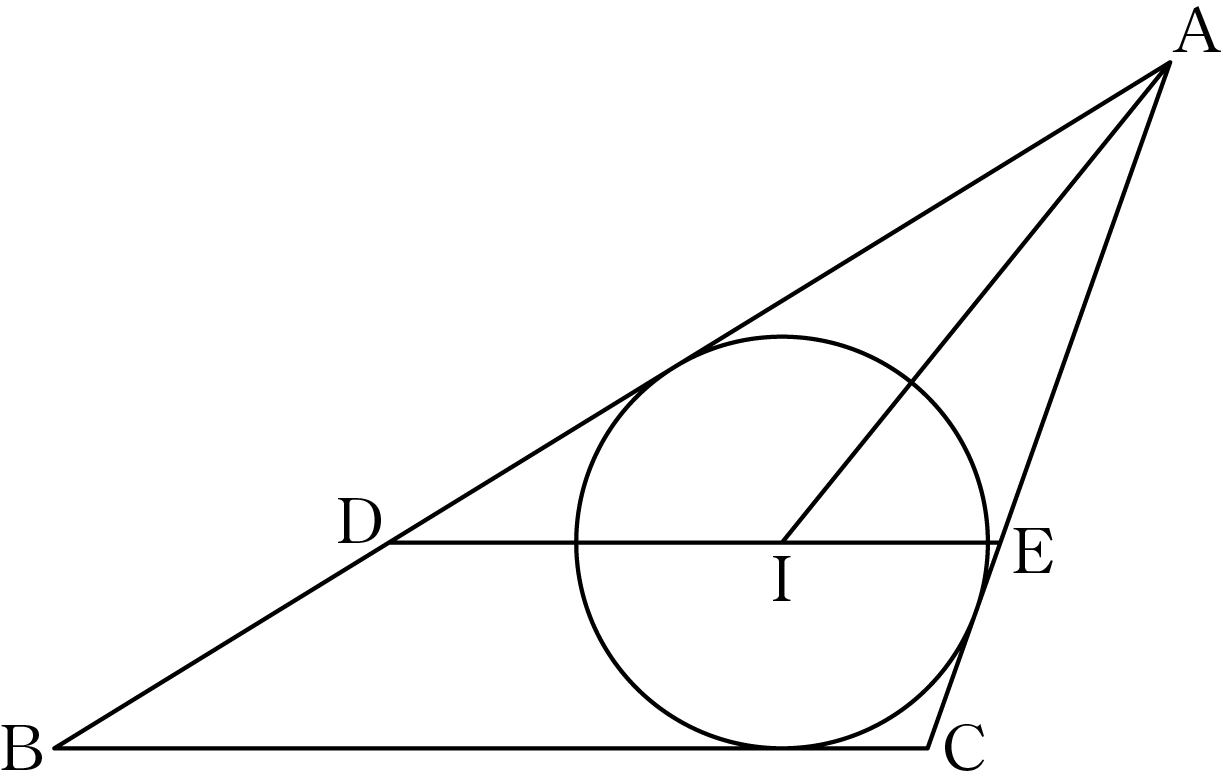
[출제의도] 삼각형의 내심의 성질과 피타고라스 정리를 이용하여 참, 거짓을 추론한다.
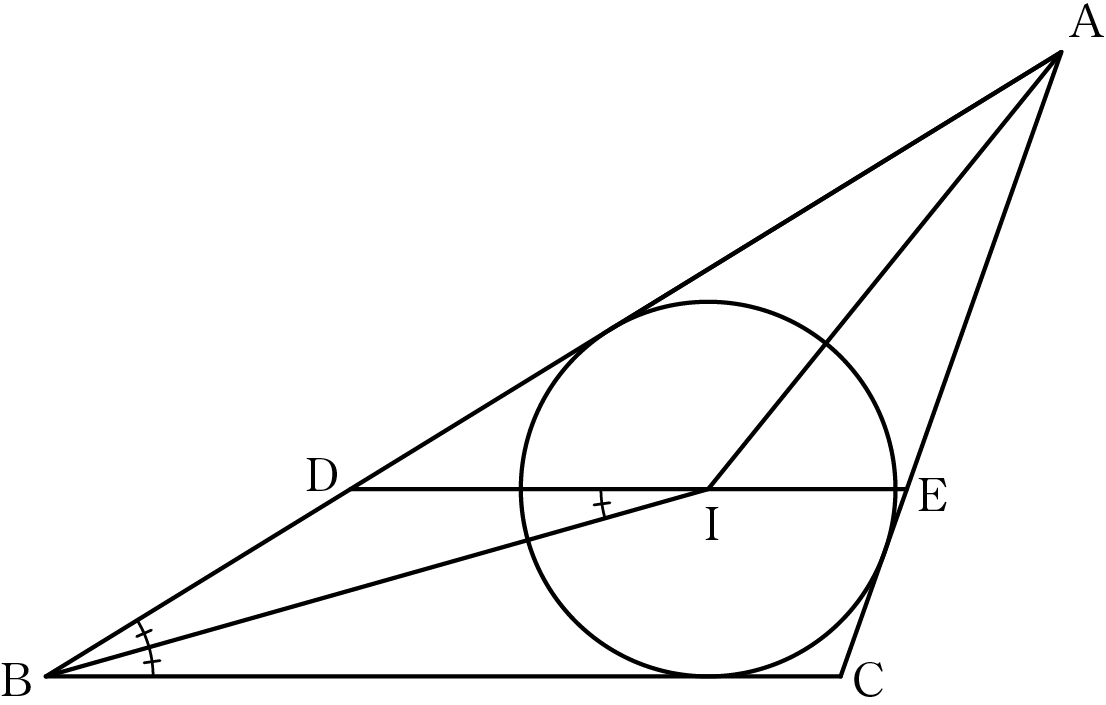
ㄱ. 직선 D E \mathrm{DE} DE B C \mathrm{BC} BC ∠ I B C = ∠ B I D \mathrm{\angle} IBC = \angle BID ∠ I B C = ∠ B I D I \mathrm{I} I A B C \mathrm{ABC} ABC ∠ I B C = ∠ I B D \mathrm{\angle} IBC = \angle IBD ∠ I B C = ∠ I B D ∠ B I D = ∠ I B D \mathrm{\angle} BID = \angle IBD ∠ B I D = ∠ I B D
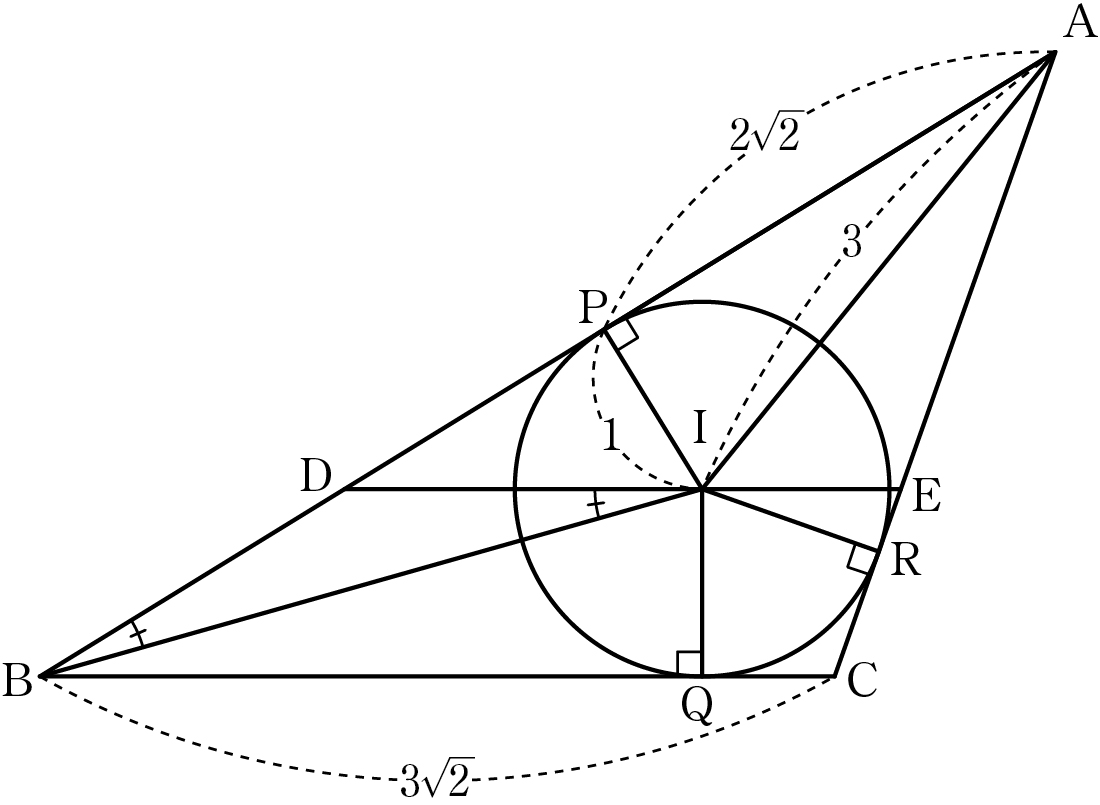
ㄴ. ∠ B I D = ∠ I B D \mathrm{\angle} BID = \angle IBD ∠ B I D = ∠ I B D D B I \mathrm{DBI} DBI D B ‾ = D I ‾ \displaystyle \mathrm{\overline{DB}} = \overline{DI} DB = D I A B ‾ \displaystyle \mathrm{\overline{AB}} AB = A D ‾ + D B ‾ \displaystyle \mathrm{=} \mathrm{\overline{AD}} + {\overline{DB}} = AD + D B = A D ‾ + D I ‾ \displaystyle \mathrm{=} {\overline{AD}} + {\overline{DI}} = A D + D I C A ‾ = I E ‾ + E A ‾ \displaystyle \mathrm{\overline{CA}} = \mathrm{\overline{IE}} + {\overline{EA}} CA = IE + E A D E ‾ = D I ‾ + I E ‾ \displaystyle \mathrm{\overline{DE}} = \mathrm{\overline{DI}} + {\overline{IE}} DE = DI + I E A D E \mathrm{ADE} ADE A D ‾ + D E ‾ + E A ‾ \displaystyle \mathrm{\overline{AD}} + {\overline{DE}} + {\overline{EA}} AD + D E + E A = A D ‾ + ( D I ‾ + I E ‾ ) + E A ‾ \displaystyle \mathrm{=} {\overline{AD}} + \left( {\overline{DI}} + {\overline{IE}} \right) + {\overline{EA}} = A D + ( D I + I E ) + E A = ( A D ‾ + D I ‾ ) + ( I E ‾ + E A ‾ ) \displaystyle \mathrm{=} \left( {\overline{AD}} + {\overline{DI}} \right) + \left( {\overline{IE}} + {\overline{EA}} \right) = ( A D + D I ) + ( I E + E A ) = A B ‾ + C A ‾ \displaystyle \mathrm{=} {\overline{AB}} + {\overline{CA}} = A B + C A I \mathrm{I} I A B \mathrm{AB} AB B C \mathrm{BC} BC C A \mathrm{CA} CA P \mathrm{P} P Q \mathrm{Q} Q R \mathrm{R} R A P ‾ \displaystyle \mathrm{\overline{AP}} AP = 3 2 − 1 2 \displaystyle = \sqrt{3 ^{2} - 1 ^{2}} = 3 2 − 1 2 = 2 2 \displaystyle = 2 \sqrt{2} = 2 2 A P ‾ \displaystyle \mathrm{\overline{AP}} AP R A ‾ \displaystyle \mathrm{\overline{RA}} RA A \mathrm{A} A A P ‾ = R A ‾ \displaystyle \mathrm{\overline{AP}} = {\overline{RA}} AP = R A P B ‾ = B Q ‾ \displaystyle \mathrm{\overline{PB}} = {\overline{BQ}} PB = B Q Q C ‾ = C R ‾ \displaystyle \mathrm{\overline{QC}} = {\overline{CR}} QC = C R △ A B C \triangle \mathrm{ABC} △ ABC = △ A B I + △ B C I + △ C A I = \mathrm{\triangle} ABI + \triangle BCI + \triangle CAI = △ A B I + △ B C I + △ C A I = 1 2 × A B ‾ × 1 + 1 2 × B C ‾ × 1 + 1 2 × C A ‾ × 1 \displaystyle = \frac{1}{2} \times \mathrm{\overline{AB}} \times 1 + \frac{1}{2} \times \mathrm{\overline{BC}} \times 1 + \frac{1}{2} \times \mathrm{\overline{CA}} \times 1 = 2 1 × AB × 1 + 2 1 × BC × 1 + 2 1 × CA × 1 = 1 2 × ( A B ‾ + B C ‾ + C A ‾ ) \displaystyle = \frac{1}{2} \times \left( \mathrm{\overline{AB}} + {\overline{BC}} + {\overline{CA}} \right) = 2 1 × ( AB + B C + C A ) = 1 2 × ( A P ‾ + P B ‾ + B Q ‾ + Q C ‾ + C R ‾ + R A ‾ ) \displaystyle = \frac{1}{2} \times \left( \mathrm{\overline{AP}} + \mathrm{\overline{PB}} + {\overline{BQ}} + \mathrm{\overline{QC}} + {\overline{CR}} + \mathrm{\overline{RA}} \right) = 2 1 × ( AP + PB + B Q + QC + C R + RA ) = 1 2 × ( 4 2 + 2 P B ‾ + 2 C R ‾ ) \displaystyle \mathrm{=} \frac{1}{2} \times \left( 4 \sqrt{2} + 2 {\overline{PB}} + 2 {\overline{CR}} \right) = 2 1 × ( 4 2 + 2 P B + 2 C R ) = 2 2 + P B ‾ + C R ‾ \displaystyle \mathrm{=} 2 \sqrt{2} + {\overline{PB}} + {\overline{CR}} = 2 2 + P B + C R = 5 2 \displaystyle = 5 \sqrt{2} = 5 2 P B ‾ + C R ‾ = 3 2 \displaystyle \mathrm{\overline{PB}} + {\overline{CR}} = 3 \sqrt{2} PB + C R = 3 2 A D E \mathrm{ADE} ADE A D ‾ + D E ‾ + E A ‾ \displaystyle \mathrm{\overline{AD}} + {\overline{DE}} + {\overline{EA}} AD + D E + E A = A B ‾ + C A ‾ \displaystyle \mathrm{=} {\overline{AB}} + {\overline{CA}} = A B + C A = A P ‾ + P B ‾ + C R ‾ + R A ‾ \displaystyle \mathrm{=} {\overline{AP}} + {\overline{PB}} + {\overline{CR}} + {\overline{RA}} = A P + P B + C R + R A = 4 2 + P B ‾ + C R ‾ \displaystyle \mathrm{=} 4 \sqrt{2} + {\overline{PB}} + {\overline{CR}} = 4 2 + P B + C R = 4 2 + 3 2 \displaystyle = 4 \sqrt{2} + 3 \sqrt{2} = 4 2 + 3 2 = 7 2 \displaystyle = 7 \sqrt{2} = 7 2
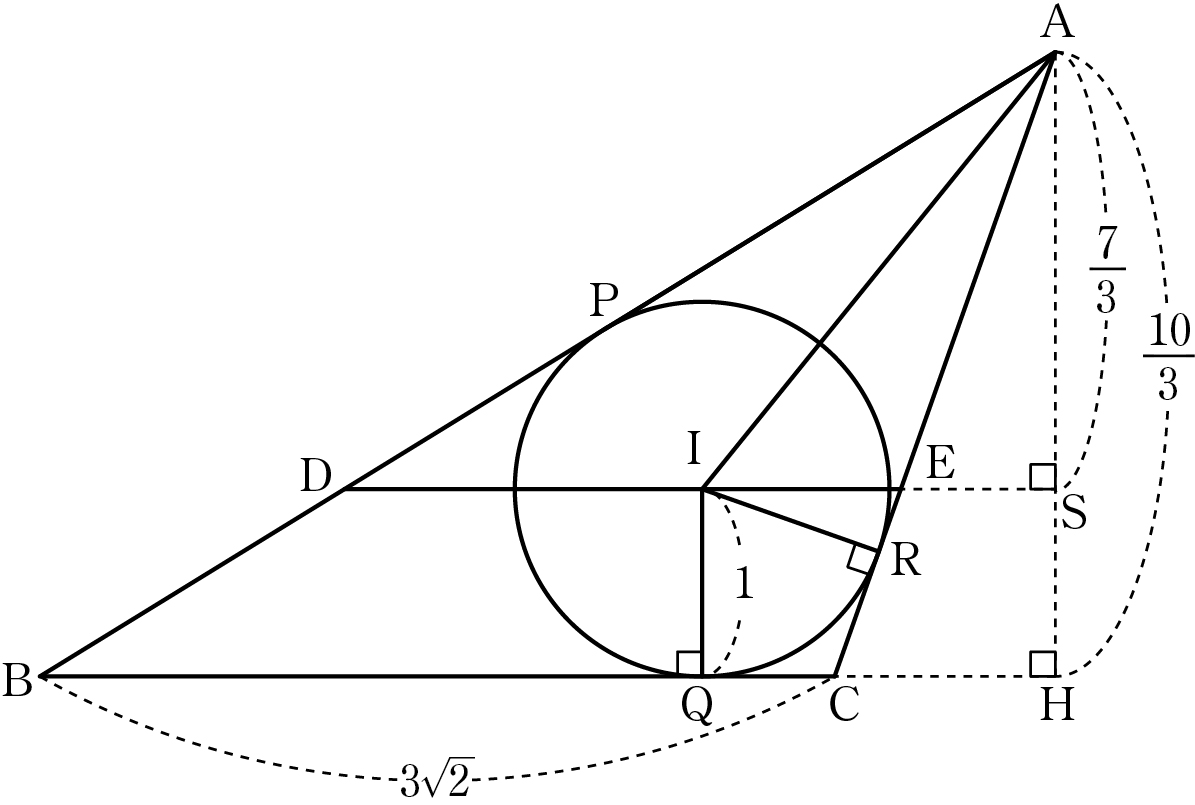
ㄷ. P B ‾ = B Q ‾ \displaystyle \mathrm{\overline{PB}} = {\overline{BQ}} PB = B Q Q C ‾ = C R ‾ \displaystyle \mathrm{\overline{QC}} = {\overline{CR}} QC = C R B C ‾ \displaystyle \mathrm{\overline{BC}} BC = B Q ‾ + Q C ‾ \displaystyle \mathrm{=} {\overline{BQ}} + {\overline{QC}} = B Q + QC = P B ‾ + C R ‾ \displaystyle = \mathrm{\overline{PB}} + {\overline{CR}} = PB + C R = 3 2 \displaystyle = 3 \sqrt{2} = 3 2 A \mathrm{A} A B C \mathrm{BC} BC H \mathrm{H} H △ A B C \mathrm{\triangle} ABC △ A B C = 1 2 × B C ‾ × A H ‾ \displaystyle = \frac{1}{2} \times \mathrm{\overline{BC}} \times \mathrm{\overline{AH}} = 2 1 × BC × AH = 1 2 × 3 2 × A H ‾ \displaystyle = \frac{1}{2} \times 3 \sqrt{2} \times \mathrm{\overline{AH}} = 2 1 × 3 2 × AH = 5 2 \displaystyle = 5 \sqrt{2} = 5 2 A H ‾ = 10 3 \displaystyle \mathrm{\overline{AH}} = \frac{10}{3} AH = 3 10 D E \mathrm{DE} DE A H \mathrm{AH} AH S \mathrm{S} S ∠ B Q I = ∠ B H A = 90 ∘ \mathrm{\angle} BQI = \angle BHA = 90 ^\circ ∠ B Q I = ∠ B H A = 9 0 ∘ I Q \mathrm{IQ} IQ A H \mathrm{AH} AH B C \mathrm{BC} BC D E \mathrm{DE} DE I Q H S \mathrm{IQHS} IQHS S H ‾ = I Q ‾ = 1 \displaystyle \mathrm{\overline{SH}} = {\overline{IQ}} = 1 SH = I Q = 1 A S ‾ \displaystyle \mathrm{\overline{AS}} AS = A H ‾ − S H ‾ \displaystyle = \mathrm{\overline{AH}} - \mathrm{\overline{SH}} = AH − SH = 10 3 − 1 \displaystyle = \frac{10}{3} - 1 = 3 10 − 1 = 7 3 \displaystyle = \frac{7}{3} = 3 7 ∠ B A C \mathrm{\angle} BAC ∠ B A C ∠ A D E = ∠ A B C \mathrm{\angle} ADE = \angle ABC ∠ A D E = ∠ A B C A B C \mathrm{ABC} ABC A D E \mathrm{ADE} ADE 10 3 : 7 3 = 10 : 7 \displaystyle \frac{10}{3} : \frac{7}{3} = 10 : 7 3 10 : 3 7 = 10 : 7 D E ‾ \displaystyle \mathrm{\overline{DE}} DE = 7 10 × B C ‾ \displaystyle = \frac{7}{10} \times \mathrm{\overline{BC}} = 10 7 × BC = 7 10 × 3 2 \displaystyle = \frac{7}{10} \times 3 \sqrt{2} = 10 7 × 3 2 = 21 10 2 \displaystyle = \frac{21}{10} \sqrt{2} = 10 21 2