중학중학 미분류수능 기출킬러 문제 (22·30번 수준)

정육각형 종이 접기

문제

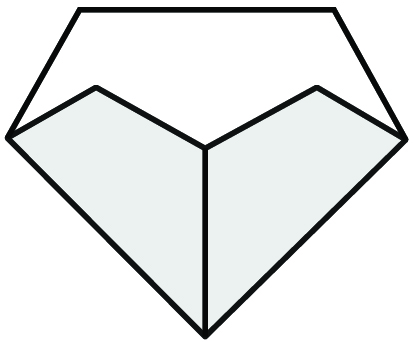
한 변의 길이가 4\mathrm{4}인 정육각형 모양의 종이를 다음과 같이 차례로 접는다.

A\mathrm{A}와 점 F\mathrm{F}가 겹쳐지도록 접었다가 편 후, 점 A\mathrm{A}와 점 C\mathrm{C}가 겹쳐지도록 접었다가 펴준다.
CD\displaystyle \mathrm{\overline{CD}}BE\displaystyle \mathrm{\overline{BE}}와 겹쳐지도록 접는다. 이때 새로 생긴 두 꼭짓점을 M\mathrm{M}, N\mathrm{N}이라 하고 MN\displaystyle \mathrm{\overline{MN}}, AF\displaystyle \mathrm{\overline{AF}}의 중점을 각각 rmrmX\mathrm{X}, Y\mathrm{Y}라 하자.
XM\displaystyle \mathrm{\overline{XM}}XN\displaystyle \mathrm{\overline{XN}}XY\displaystyle \mathrm{\overline{XY}}와 겹쳐지도록 접는다.

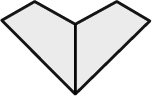
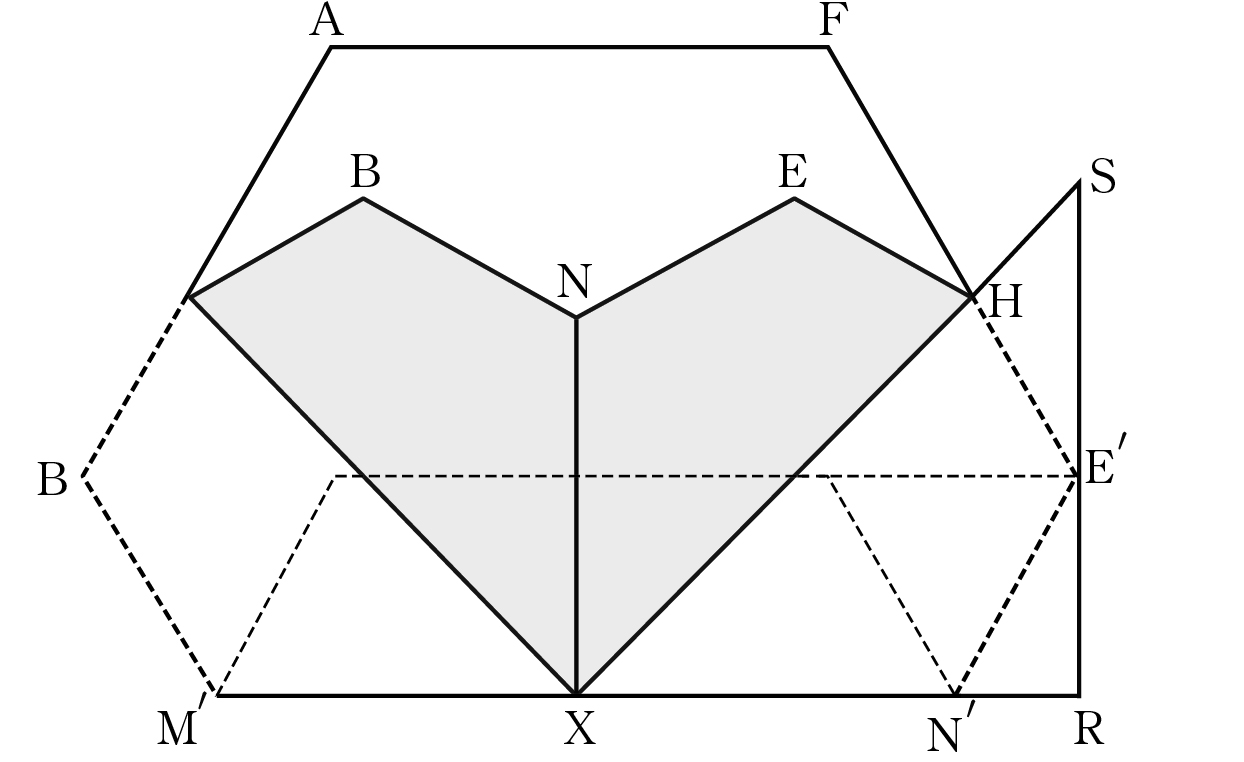
아래 그림은 위와 같은 방법으로 접은 모양을 나타낸 것이다.

이 그림의 어두운 부분인 모양의 넓이가 a+b3\displaystyle a + b \sqrt{3}일 때, a+ba + b의 값을 구하시오. (단, aa, bb는 유리수이고, 종이의 두께는 무시한다.) [4점]

정답 보기
23

자료 내려받기

아직 올라온 파일이 없습니다.

해설

[출제의도] 도형의 성질과 삼각비를 이용하여 실생활 문제를 해결한다.

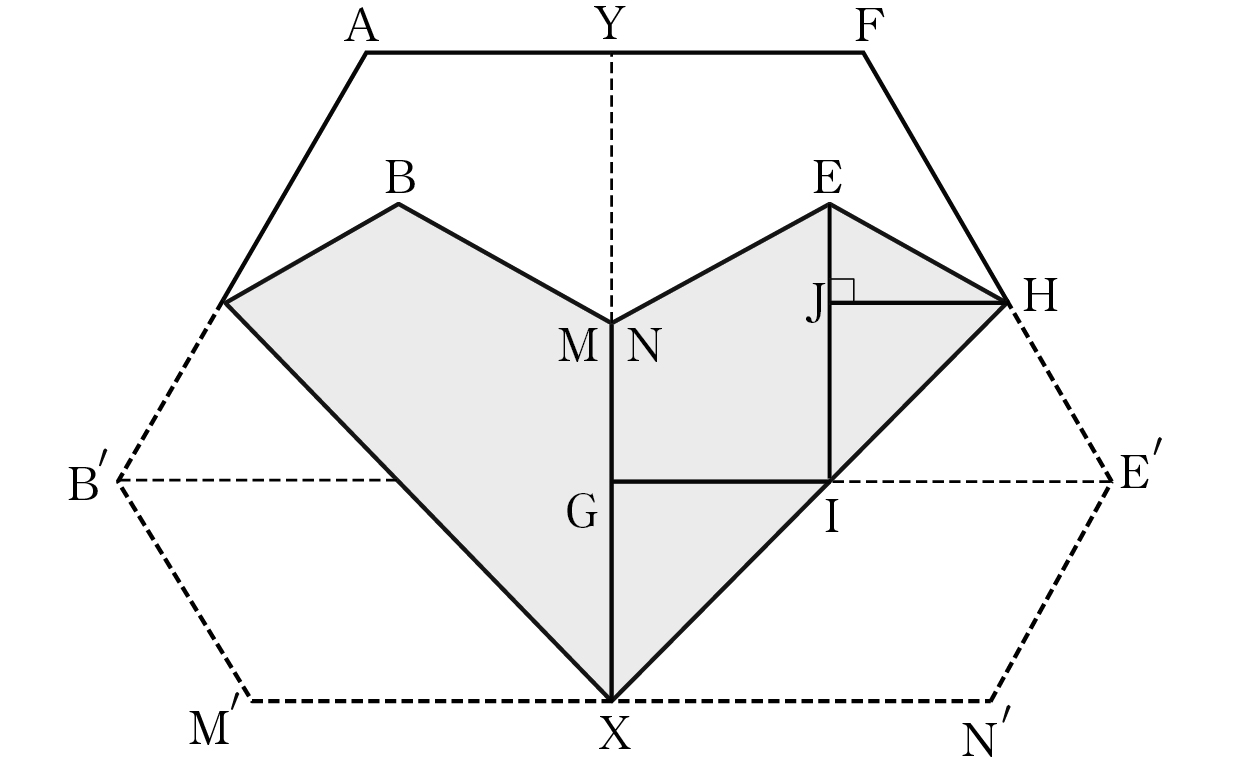
그림에서 BE\displaystyle \mathrm{\overline{B' E'}}XH\displaystyle \mathrm{\overline{XH}}가 만나는 점을 I\mathrm{I}라 하면 NXEI\displaystyle \mathrm{\overline{NX}} \parallel {\overline{EI}}이므로 사각형 NΞE\mathrm{N} \Xi E는 사다리꼴이다. BEMN\displaystyle \mathrm{\overline{B' E'}} \parallel {\overline{M' N'}}이므로 GΞ=GIX=45\mathrm{\angle} G \Xi = \angle GIX = 45 ^\circ GΞ\mathrm{\triangle} G \XiGX=GI\displaystyle \mathrm{\overline{GX}} = {\overline{GI}}인 이등변삼각형이다. 2GX=GY\displaystyle \mathrm{2} {\overline{GX}} = {\overline{GY}}, GY=23\displaystyle \mathrm{\overline{GY}} = 2 \sqrt{3}이므로 GX=GI=3\displaystyle \mathrm{\overline{GX}} = {\overline{GI}} = \sqrt{3} IE=IE=GEGI=43\displaystyle \mathrm{\overline{IE}} = {\overline{IE'}} = {\overline{G E'}} - {\overline{GI}} = 4 - \sqrt{3} MN=12×(BE+AF)\displaystyle \mathrm{\overline{M' N'}} = \frac{1}{2} \times \left( {\overline{B' E'}} + {\overline{AF}} \right)이므로 MN=6\displaystyle \mathrm{\overline{M' N'}} = 6이다. NX=NX=12MN=3\displaystyle \mathrm{\overline{NX}} = {\overline{N' X}} = \frac{1}{2} {\overline{M' N'}} = 3이므로 사다리꼴 NΞE\mathrm{N} \Xi E의 넓이는 12×{3+(43)}×3\displaystyle \frac{1}{2} \times \left\{ 3 + \left( 4 - \sqrt{3} \right) \right\} \times \sqrt{3}=3+732\displaystyle = \frac{- 3 + 7 \sqrt{3}}{2} …… ㉠ EIE=90\mathrm{\angle} EIE' = 90 ^\circ이므로 EIH=45\mathrm{\angle} EIH = 45 ^\circ이다. 점 H\mathrm{H}에서 EI\displaystyle \mathrm{\overline{EI}}에 내린 수선의 발을 J\mathrm{J}라 하면 HEI=HEJ=60\mathrm{\angle} HE' I = \angle HEJ = 60 ^\circ HJ=h\displaystyle {\mathrm{\overline{HJ}}} = h라 하면 EJ\displaystyle \mathrm{\overline{EJ}}=htan60\displaystyle = \frac{h}{\tan 60 ^\circ}, JI\displaystyle \mathrm{\overline{JI}}=htan45\displaystyle = \frac{h}{\tan 45 ^\circ} EI\displaystyle \mathrm{\overline{EI}}=EJ+JI\displaystyle = \mathrm{\overline{EJ}} + \mathrm{\overline{JI}}=43\displaystyle = 4 - \sqrt{3}이므로 h×(1tan60+1tan45)=43\displaystyle h \times \left( \frac{1}{\tan 60 ^\circ} + \frac{1}{\tan 45 ^\circ} \right) = 4 - \sqrt{3} h=15732\displaystyle h = \frac{15 - 7 \sqrt{3}}{2} 삼각형 EIH\mathrm{EIH}의 넓이는 12×(43)×(15732)\displaystyle \frac{1}{2} \times \left( 4 - \sqrt{3} \right) \times \left( \frac{15 - 7 \sqrt{3}}{2} \right)=814334\displaystyle = \frac{81 - 43 \sqrt{3}}{4} …… ㉡ ㉠, ㉡에서 구하는 넓이는 2×{(3+732)+(814334)}\displaystyle 2 \times \left\{ \left( \frac{- 3 + 7 \sqrt{3}}{2} \right) + \left( \frac{81 - 43 \sqrt{3}}{4} \right) \right\}=7522923\displaystyle = \frac{75}{2} - \frac{29}{2} \sqrt{3} a=752\displaystyle a = \frac{75}{2}, b=292\displaystyle b = \mathit{-} \frac{29}{2} 이므로 a+ba + b=752+(292)=23\displaystyle = \frac{75}{2} + \left( - \frac{29}{2} \right) = 23 [다른 풀이]

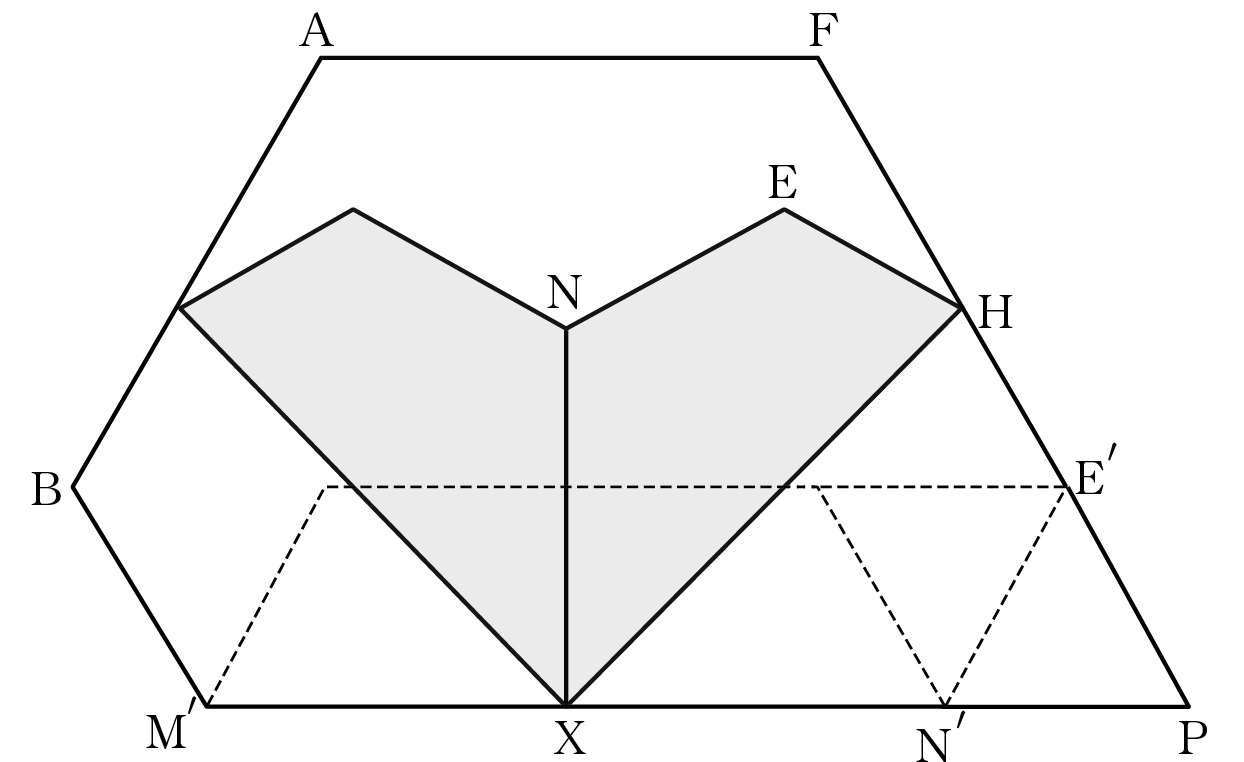
그림에서 두 사각형 XNEH\mathrm{XNEH}XNEH\mathrm{XN}' E' H는 합동이다. FE\displaystyle {\overline{\mathrm{FE}'}}의 연장선과 MN\displaystyle {\overline{\mathrm{M}' N'}}의 연장선이 만나는 점을 P\mathrm{P}라 하면 삼각형 ENP\mathrm{E}' N' P는 한 변의 길이가 22인 정삼각형이고 그 넓이는 12×2×3\displaystyle \frac{1}{2} \times 2 \times \sqrt{3}=3\displaystyle = \sqrt{3}이다.

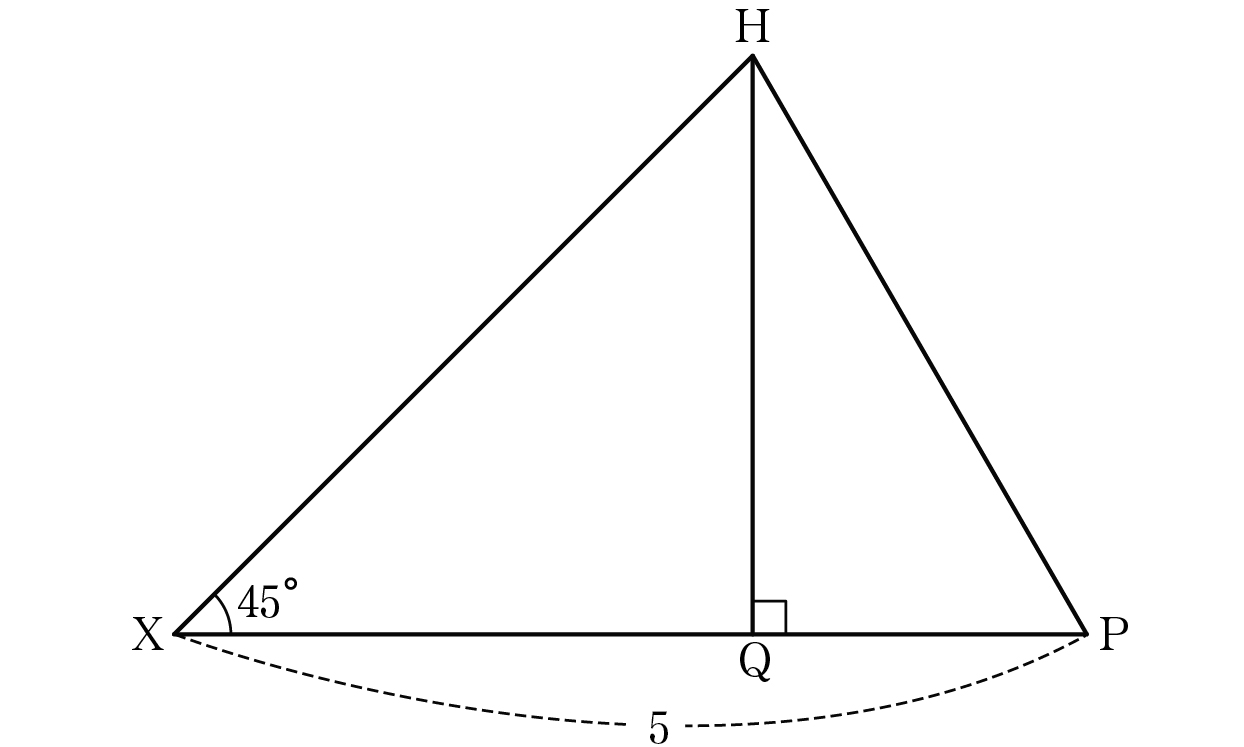
H\mathrm{H}에서 XP\displaystyle {\overline{\mathrm{XP}}}에 내린 수선의 발을 Q\mathrm{Q}라 하고 QP=x\displaystyle {\overline{\mathrm{QP}}} = x라 하자. 직각삼각형 HQP\mathrm{HQP}에서 HPQ=60\mathrm{\angle} HPQ = 60 ^\circ이므로 HQ=3x\displaystyle {\overline{\mathrm{HQ}}} = \sqrt{3} x 직각삼각형 HXQ\mathrm{HXQ}에서 HXQ=45\mathrm{\angle} HXQ = 45 ^\circ이므로 XQ\displaystyle {\overline{\mathrm{XQ}}}=HQ=3x\displaystyle = {\overline{\mathrm{HQ}}} = \sqrt{3} x XP=XQ+QP\displaystyle {\overline{\mathrm{XP}}} \mathit{=} {\overline{\mathrm{XQ}}} \mathit{+} {\overline{\mathrm{QP}}}=x+3x\displaystyle = x + \sqrt{3} x=5= 5이므로 x=53+1\displaystyle x = \frac{5}{\sqrt{3} + 1}=5(31)2\displaystyle = \frac{5 \left( \sqrt{3} - 1 \right)}{2} 삼각형 HXP\mathrm{HXP}의 넓이는 12×XP×HQ\displaystyle \frac{1}{2} \times {\overline{\mathrm{XP}}} \times {\overline{\mathrm{HQ}}}=12×5×3x\displaystyle = \frac{1}{2} \times 5 \times \sqrt{3} x =532x\displaystyle = \frac{5 \sqrt{3}}{2} x =532×5(31)2\displaystyle = \frac{5 \sqrt{3}}{2} \times \frac{5 \left( \sqrt{3} - 1 \right)}{2} =752534\displaystyle = \frac{75 - 25 \sqrt{3}}{4} 사각형 XNEH\mathrm{XN}' E' H의 넓이는 삼각형 HXP\mathrm{HXP}의 넓이에서 삼각형 ENP\mathrm{E}' N' P의 넓이를 뺀 것과 같으므로 7525343\displaystyle \frac{75 - 25 \sqrt{3}}{4} - \sqrt{3}=752934\displaystyle = \frac{75 - 29 \sqrt{3}}{4} 그러므로 구하는 도형의 넓이는 2×752934\displaystyle 2 \times \frac{75 - 29 \sqrt{3}}{4}=7522923\displaystyle = \frac{75}{2} - \frac{29}{2} \sqrt{3} 따라서 a=752\displaystyle a = \frac{75}{2}, b=292\displaystyle b = \mathit{-} \frac{29}{2}이므로 a+b=23a + b = 23 [다른 풀이]

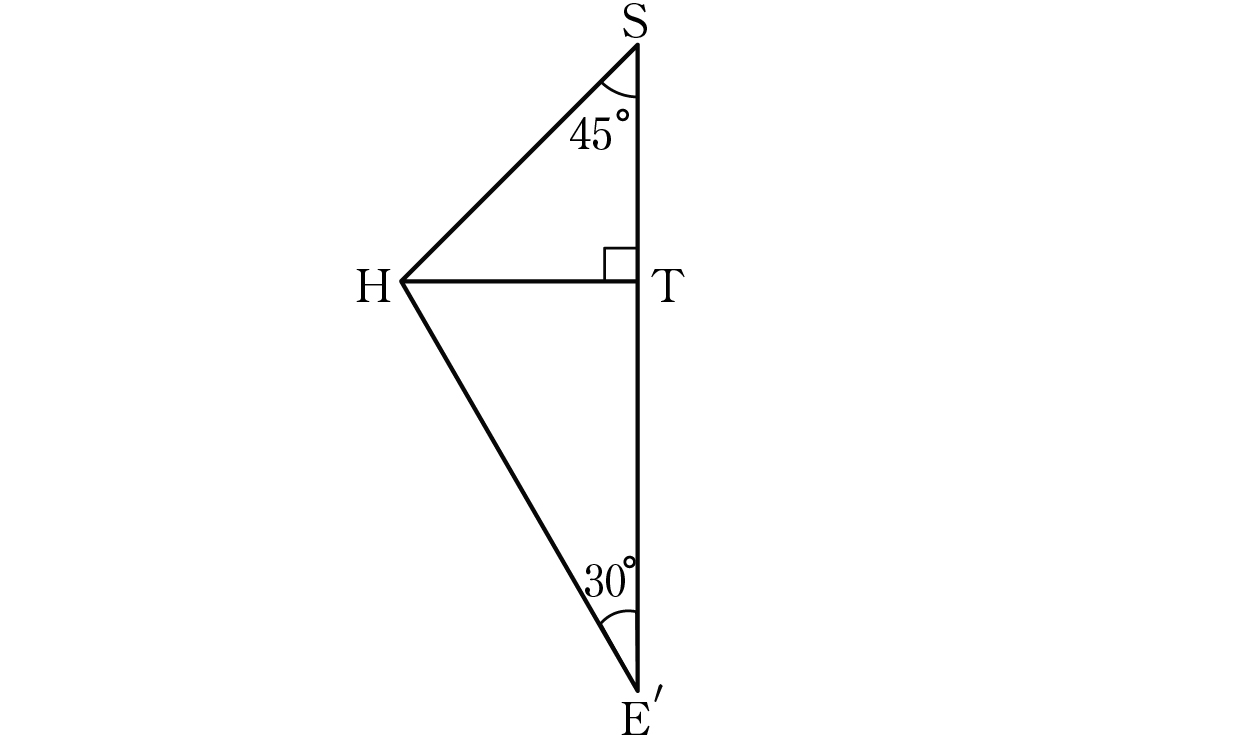
그림에서 두 사각형 XNEH\mathrm{XNEH}XNEH\mathrm{XN}' E' H는 합동이다. 점 E\mathrm{E}'을 지나고 직선 XN\mathrm{XN}에 평행한 직선이 XN\displaystyle \mathrm{\overline{XN'}}의 연장선과 만나는 점을 R\mathrm{R}, XH\displaystyle \mathrm{\overline{XH}}의 연장선과 만나는 점을 S\mathrm{S}라 하자. 직각삼각형 XRS\mathrm{XRS}에서 SXR=45\angle \mathrm{SXR} = 45 ^\circ, XR=4\displaystyle \mathrm{\overline{XR}} = 4이므로 삼각형 XRS\mathrm{XRS}의 넓이는 12×4×4\displaystyle \frac{1}{2} \times 4 \times 4=8= 8 직각삼각형 NRE\mathrm{N}' RE'에서 NR=XRXN=43=1\displaystyle \mathrm{\overline{N' R}} = {\overline{XR}} - {\overline{XN'}} = 4 - 3 = 1, RE=3\displaystyle \mathrm{\overline{RE'}} = \sqrt{3}이므로 삼각형 NRE\mathrm{N}' RE'의 넓이는 12×1×3\displaystyle \frac{1}{2} \times 1 \times \sqrt{3}=32\displaystyle = \frac{\sqrt{3}}{2} 삼각형 HES\mathrm{HE}' S에서 HSE=45\angle \mathrm{HSE}' = 45 ^\circ, HES=30\angle \mathrm{HE}' S = 30 ^\circ이므로 SHE=105\angle \mathrm{SHE}' = 105 ^\circ이다. 삼각형 HES\mathrm{HE}' S를 그리면 다음과 같다.

H\mathrm{H}에서 변 SE\mathrm{SE}'에 내린 수선의 발을 T\mathrm{T}라 하고 ST=x\displaystyle {\overline{\mathrm{ST}}} = x라 하자. 직각삼각형 SHT\mathrm{SHT}에서 HST=45\mathrm{\angle} HST = 45 ^\circ이므로 HT=x\displaystyle {\overline{\mathrm{HT}}} = x 직각삼각형 HET\mathrm{HE}' T에서 HET=30\angle \mathrm{HE}' T = 30 ^\circ이므로 ET=3x\displaystyle {\overline{\mathrm{E}' T}} = \sqrt{3} x 한편 SE=SRRE=43\displaystyle {\overline{\mathrm{SE}'}} \mathit{=} \mathrm{\overline{SR}} - {\overline{RE'}} = 4 - \sqrt{3}이고 SE=ST+TE\displaystyle {\overline{\mathrm{SE}'}} \mathit{=} {\overline{\mathrm{ST}}} \mathit{+} {\overline{\mathrm{TE}'}}=x+3x\displaystyle = x + \sqrt{3} x이므로 x+3x=43\displaystyle x + \sqrt{3} x = 4 - \sqrt{3} x=433+1\displaystyle x = \frac{4 - \sqrt{3}}{\sqrt{3} + 1}=5372\displaystyle = \frac{5 \sqrt{3} - 7}{2} 삼각형 HES\mathrm{HE}' S의 넓이는 12×SE×HT\displaystyle \frac{1}{2} \times {\overline{\mathrm{SE}'}} \times {\overline{\mathrm{HT}}}=12×(43)×5372\displaystyle = \frac{1}{2} \times \left( 4 - \sqrt{3} \right) \times \frac{5 \sqrt{3} - 7}{2}=273434\displaystyle = \frac{27 \sqrt{3} - 43}{4} 사각형 XNEH\mathrm{XN}' E' H의 넓이는 삼각형 XRS\mathrm{XRS}의 넓이에서 두 삼각형 NRE\mathrm{N}' RE'HES\mathrm{HE}' S의 넓이를 뺀 것과 같다. XNEH\mathrm{XN}' E' H의 넓이는 8(32+273434)\displaystyle 8 - \left( \frac{\sqrt{3}}{2} + \frac{27 \sqrt{3} - 43}{4} \right)=752934\displaystyle = \frac{75 - 29 \sqrt{3}}{4} 그러므로 구하는 도형의 넓이는 2×752934\displaystyle 2 \times \frac{75 - 29 \sqrt{3}}{4}=7522923\displaystyle = \frac{75}{2} - \frac{29}{2} \sqrt{3} 따라서 a=752\displaystyle a = \frac{75}{2}, b=292\displaystyle b = \mathit{-} \frac{29}{2}이므로 a+b=23a + b = 23

태그

비슷한 문제 더 보기

← 전체 문제 목록으로