중학중학 미분류수능 기출킬러 문제 (22·30번 수준)

평행사변형과 내심

문제

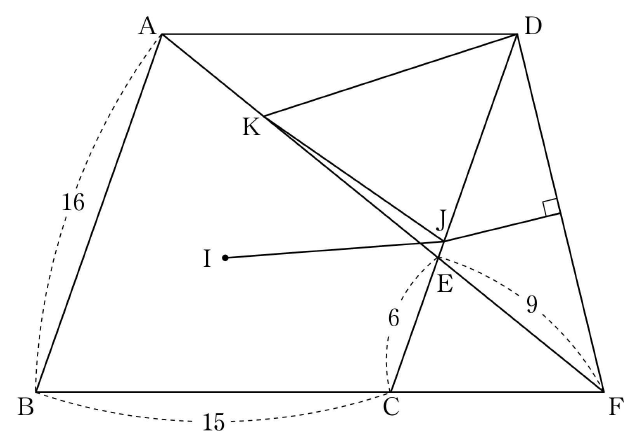
그림과 같이 AB=16\displaystyle {\overline{\mathrm{AB}}} = 16, BC=15\displaystyle {\overline{\mathrm{BC}}} = 15, B<90\angle {\mathrm{B}} < 90 ^\circ인 평행사변형 ABCD{\mathrm{ABCD}}의 변 CD{\mathrm{CD}} 위에 CE=6\displaystyle {\overline{\mathrm{CE}}} = 6인 점 E{\mathrm{E}}가 있다. 직선 BC{\mathrm{BC}}와 직선 AE{\mathrm{AE}}의 교점을 F{\mathrm{F}}라 할 때, EF=9\displaystyle {\overline{\mathrm{EF}}} = 9이다. 삼각형 ABF{\mathrm{ABF}}의 내심을 I{\mathrm{I}}, 선분 DF{\mathrm{DF}}의 수직이등분선과 직선 CD{\mathrm{CD}}의 교점을 J{\mathrm{J}}라 할 때, 선분 AE{\mathrm{AE}} 위의 점 K{\mathrm{K}}IJ=KJ\displaystyle {\overline{\mathrm{IJ}}} = {\overline{\mathrm{KJ}}}를 만족시킨다. tan(FKD)=q2p\displaystyle \tan \left( \angle {\mathrm{FKD}} \right) = \frac{q \sqrt{2}}{p}일 때, p+qp + q의 값을 구하시오. (단, ppqq는 서로소인 자연수이다.) [4점]

정답 보기
25

자료 내려받기

아직 올라온 파일이 없습니다.

해설

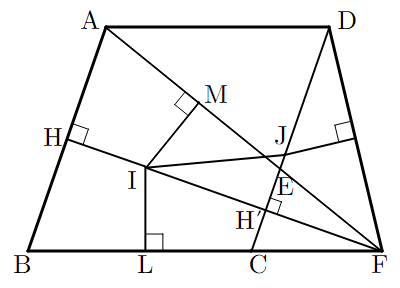
평행사변형 ABCD{\mathrm{ABCD}}에서 DC=AB=16\displaystyle {\overline{\mathrm{DC}}} = {\overline{\mathrm{AB}}} = 16, AD=BC=15\displaystyle {\overline{\mathrm{AD}}} = {\overline{\mathrm{BC}}} = 15 ED=CDCE=166=10\displaystyle {\overline{\mathrm{ED}}} = {\overline{\mathrm{CD}}} - {\overline{\mathrm{CE}}} = 16 - 6 = 10 두 삼각형 FEC{\mathrm{FEC}}, AED{\mathrm{AED}}에서 CEF=DEA\angle {\mathrm{CEF}} = \angle {\mathrm{DEA}} (맞꼭지각), FCE=ADE\angle {\mathrm{FCE}} = \angle {\mathrm{ADE}} (엇각)이므로 두 삼각형 FEC{\mathrm{FEC}}, AED{\mathrm{AED}}는 서로 닮은 도형이다. 닮음비는 CE:DE=6:10=3:5\displaystyle {\overline{\mathrm{CE}}} : {\overline{\mathrm{DE}}} = 6 : 10 = 3 : 5 FC:AD=3:5\displaystyle {\overline{\mathrm{FC}}} : {\overline{\mathrm{AD}}} = 3 : 5이고 AD=15\displaystyle {\overline{\mathrm{AD}}} = 15이므로 FC=9\displaystyle {\overline{\mathrm{FC}}} = 9 그러므로 삼각형 FEC{\mathrm{FEC}}FE=FC=9\displaystyle {\overline{\mathrm{FE}}} = {\overline{\mathrm{FC}}} = 9인 이등변삼각형이다. \cdots\cdots ㉠ 두 삼각형 FEC{\mathrm{FEC}}, FAB{\mathrm{FAB}}에서 EFC\angle {\mathrm{EFC}}는 공통이고, FCE=FBA\angle {\mathrm{FCE}} = \angle {\mathrm{FBA}} (동위각)이므로 두 삼각형 FEC{\mathrm{FEC}}, FAB{\mathrm{FAB}}는 서로 닮은 도형이다. 닮음비는 FC:FB=924=3:8\displaystyle {\overline{\mathrm{FC}}} : {\overline{\mathrm{FB}}} = 9 - 24 = 3 : 8 ㉠에 의하여 삼각형 FAB{\mathrm{FAB}}FA=FB=24\displaystyle {\overline{\mathrm{FA}}} = {\overline{\mathrm{FB}}} = 24인 이등변삼각형이므로 각 AFB{\mathrm{AFB}}의 이등분선은 선분 AB{\mathrm{AB}}를 수직이등분한다. 각 AFB{\mathrm{AFB}}의 이등분선과 선분 AB{\mathrm{AB}}의 교점을 H{\mathrm{H}}라 하면 삼각형 FAB{\mathrm{FAB}}의 내심 I{\mathrm{I}}는 선분 FH{\mathrm{FH}} 위에 있다. 점 I{\mathrm{I}}에서 두 변 BF{\mathrm{BF}}, FA{\mathrm{FA}}에 내린 수선의 발을 각각 L{\mathrm{L}}, M{\mathrm{M}}이라 하자. 삼각형 FAB{\mathrm{FAB}}의 내접원의 반지름의 길이를 rr이라 하면 삼각형의 내심의 성질에 의하여 IH=IL=IM=r\displaystyle {\overline{\mathrm{IH}}} = {\overline{\mathrm{IL}}} = {\overline{\mathrm{IM}}} = r ABF\triangle {\mathrm{ABF}}=IAB+IBF+IFA= \triangle {\mathrm{IAB}} + \triangle {\mathrm{IBF}} + \triangle {\mathrm{IFA}} =12×AB×r+12×BF×r+12×FA×r\displaystyle = \frac{1}{2} \times {\overline{\mathrm{AB}}} \times r + \frac{1}{2} \times {\overline{\mathrm{BF}}} \times r + \frac{1}{2} \times {\overline{\mathrm{FA}}} \times r =12×(16+24+24)×r\displaystyle = \frac{1}{2} \times \left( 16 + 24 + 24 \right) \times r =32r= 32 r \cdots\cdots ㉡ 직각삼각형 FAH{\mathrm{FAH}}에서 AH=12×AB=12×16=8\displaystyle {\overline{\mathrm{AH}}} = \frac{1}{2} \times {\overline{\mathrm{AB}}} = \frac{1}{2} \times 16 = 8, FA=24\displaystyle {\overline{\mathrm{FA}}} = 24이므로 피타고라스 정리에 의하여 FH2=FA2AH2=24282=512=(162)2\displaystyle {\overline{\mathrm{FH}}} ^{2} = {\overline{\mathrm{FA}}} ^{2} - {\overline{\mathrm{AH}}} ^{2} = 24 ^{2} - 8 ^{2} = 512 = \left( 16 \sqrt{2} \right) ^{2} FH=162\displaystyle {\overline{\mathrm{FH}}} = 16 \sqrt{2} 그러므로 ABF\triangle {\mathrm{ABF}}=12×AB×FH\displaystyle = \frac{1}{2} \times {\overline{\mathrm{AB}}} \times {\overline{\mathrm{FH}}} =12×16×162=1282\displaystyle = \frac{1}{2} \times 16 \times 16 \sqrt{2} = 128 \sqrt{2} \cdots\cdots ㉢ ㉡, ㉢에서 32r=1282\displaystyle 32 r = 128 \sqrt{2}, r=42\displaystyle r = 4 \sqrt{2} 선분 FH{\mathrm{FH}}와 선분 EC{\mathrm{EC}}의 교점을 H{\mathrm{H}}'이라 할 때, 선분 FH{\mathrm{FH}}'은 선분 EC{\mathrm{EC}}를 수직이등분한다. 두 삼각형 FEH{\mathrm{FEH}}', FAH{\mathrm{FAH}}에서 FHE=FHA=90\angle {\mathrm{FH}}' {\mathrm{E}} = \angle {\mathrm{FHA}} = 90 ^\circ이고, HEF=HAF\angle {\mathrm{H}}' {\mathrm{EF}} = \angle {\mathrm{HAF}} (동위각) 이므로 두 삼각형 FEH{\mathrm{FEH}}', FAH{\mathrm{FAH}}는 서로 닮은 도형이다. 닮음비는 FE:FA=9:24=3:8\displaystyle {\overline{\mathrm{FE}}} : {\overline{\mathrm{FA}}} = 9 : 24 = 3 : 8 FH:FH=3:8\displaystyle {\overline{{\mathrm{FH}}'}} : {\overline{\mathrm{FH}}} = 3 : 8이므로 FH=38×FH=38×162=62\displaystyle {\overline{{\mathrm{FH}}'}} = \frac{3}{8} \times {\overline{\mathrm{FH}}} = \frac{3}{8} \times 16 \sqrt{2} = 6 \sqrt{2} HI\displaystyle {\overline{{\mathrm{H}}' {\mathrm{I}}}}=FHIHFH\displaystyle = {\overline{\mathrm{FH}}} - {\overline{\mathrm{IH}}} - {\overline{{\mathrm{FH}}'}}=1624262\displaystyle = 16 \sqrt{2} - 4 \sqrt{2} - 6 \sqrt{2}=62\displaystyle = 6 \sqrt{2} FH=HI=62\displaystyle {\overline{{\mathrm{FH}}'}} = {\overline{{\mathrm{H}}' {\mathrm{I}}}} = 6 \sqrt{2}이므로 직선 DH{\mathrm{DH}}'은 선분 IF{\mathrm{IF}}의 수직이등분선이다. 삼각형 DIF{\mathrm{DIF}}에서 변 FD{\mathrm{FD}}의 수직이등분선과 변 IF{\mathrm{IF}}의 수직이등분선의 교점이 J{\mathrm{J}}이므로 점 J{\mathrm{J}}는 삼각형 DIF{\mathrm{DIF}}의 외심이다.

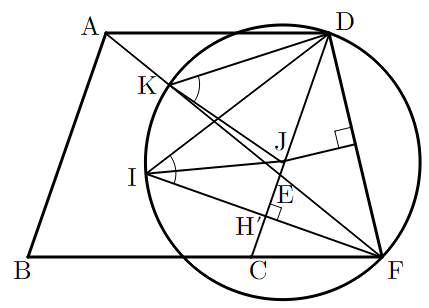
IJ=KJ\displaystyle {\overline{\mathrm{IJ}}} = {\overline{\mathrm{KJ}}}이므로 점 K{\mathrm{K}}는 삼각형 DIF{\mathrm{DIF}}의 외접원 위에 있다. 원주각의 성질에 의하여 FKD=FID\angle {\mathrm{FKD}} = \angle {\mathrm{FID}} tan(FKD)\tan \left( \angle {\mathrm{FKD}} \right)=tan(FID)=tan(HID)=DHIH\displaystyle = \tan \left( \angle {\mathrm{FID}} \right) = \tan \left( \angle {\mathrm{H}}' {\mathrm{ID}} \right) = \frac{{\overline{{\mathrm{DH}}'}}}{{\overline{{\mathrm{IH}}'}}} =DCHCIH\displaystyle = \frac{{\overline{\mathrm{DC}}} - {\overline{{\mathrm{H}}' {\mathrm{C}}}}}{{\overline{{\mathrm{IH}}'}}}=16362=13212\displaystyle = \frac{16 - 3}{6 \sqrt{2}} = \frac{13 \sqrt{2}}{12} 따라서 p=12p = 12, q=13q = 13이므로 p+q=12+13=25p + q = 12 + 13 = 25

태그

비슷한 문제 더 보기

← 전체 문제 목록으로